By Kristin Engel:
The southern African region is experiencing one of its worst droughts in decades and an estimated 20 million people now face “crisis levels of acute hunger” and water shortages amid a growing climate crisis, fuelled by the El Niño weather phenomenon.
The drought has affected critical crops and livestock, exacerbating already persistent high food prices.
A new study by the World Weather Attribution, presented on 18 April 2024, has found that the severe drought was driven primarily by El Niño, rather than human-caused climate change, and that with these El Niño conditions, droughts of this severity would likely be happening at least twice in every decade.
Given the devastating impacts of this year’s drought, the study emphasises that drought preparedness in southern Africa is critical to avoid food shortages in future El Niño years – which is expected to occur more frequently as the climate continues to warm.
- Advertisement -
The study states: “From January 2024, large parts of southern Africa experienced significantly below-average rainfall, with Zimbabwe, Zambia, Malawi, Angola, Mozambique and Botswana receiving less than 20 percent of the typical rainfall expected for February, with devastating consequences for the population largely depending on rain-fed agriculture.”
The drought also led to dramatic water shortages, particularly in Zambia and Zimbabwe, where water supply infrastructure was underdeveloped. As a consequence, the countries had been battling major outbreaks of cholera and other water-borne diseases.
The affected countries also face an increased risk of severe food insecurity between the current and the next rainy season. Zambia, Zimbabwe and Malawi have already declared a national disaster over the drought.
Scientists from Zambia, Botswana, Kenya, Mozambique, South Africa, the Netherlands, Sweden and the UK assessed in the study to what extent the 2024 El Niño-Southern Oscillation state as well as human-induced climate change altered the likelihood and intensity of the low rainfall that led to debilitating drought, and the increase in evaporation due to climate change, exacerbating drought severity.
- Advertisement -
- Advertisement -
The analyses show that El Niño significantly increases the likelihood of such drought, while climate change did not emerge as the significant driver of drought in the affected countries.
Using four different observational data products, they found that droughts such as this were expected to occur in today’s climate once every decade. However, when they considered the effect of El Niño, they found that these droughts were twice as likely to occur in El Niño years, making El Niño a key driver of the 2024 event.
To analyse the role of human-induced climate change, the relationship between global warming and rainfall anomalies in observation-based data products was analysed, with the conclusion that as global temperatures increase, rainfall between December and February also increases.
This meant that in the current climate, with 1.2°C warming, droughts such as this were less likely than in a cooler, pre-industrial climate.
To further evaluate the role of climate change in the current drought, the scientists combined the observations with climate models. They said the models that passed the model evaluation did not show a significant relationship between rainfall and global warming levels with increasing global temperatures.
Bernardino Nhantumbo, a researcher at the Mozambique National Institute of Meteorology and one of the study’s authors, said the main concern for drought in the present year started from December to January, which was the peak period for the rainy season in southern Africa and extremely important because rain-fed agriculture was the main activity for most of the communities.
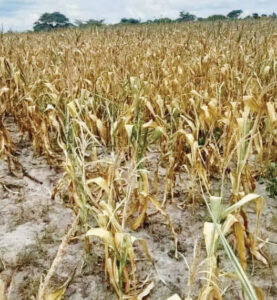
“When you have very low rainfall, it means that most of the crops will die, causing food shortages and millions of people will be affected… The drought we have been observing was mainly moving from the west side of the subcontinent to the east side, and it affected countries in different periods, but January into February was shown to be a peak of it,” he said.
Joyce Kimutai, another author of the study and researcher at the Grantham Institute, a climate change and environment centre at Imperial College London, said this study was confined to Botswana, Zimbabwe and southern parts of Zambia and Mozambique to better understand a region where the climate was similar, and the drivers of the rainfall.
“What we looked at is the rainfall deficit and effective rainfall, which is basically incorporating evapotranspiration (loss of water from soil and plants). What we found is that these very strong droughts experienced in this season are likely expected to happen at least once every 10 years. So, every decade we’re likely to see these [droughts] in this current climate where we have a warming of at least 1.5°C.
“But then we went ahead to understand what would be the influence of El Niño; 2023 was a strong El Niño year and this means it was one of the warmest years on record. We realised that with these El Niño conditions, we are likely to see such droughts happening at least twice in every decade,” she said.
In El Niño years, Kimutai said they found that these droughts were becoming twice as likely.
“It was very clear from our analysis that the El Niño played a key role in the severity of the drought conditions that were experienced, and we couldn’t find a very clear role of climate change so we didn’t consider it a significant driver for this drought.”
She said El Niño events will continue to happen and there had been research that showed their cycles were continuing more frequently; they used to be maybe once every seven years, but studies now show they happen at least once every three to five years.
“Over the past year, attribution studies have shown that many extreme weather events have been driven by a combination of both climate change and El Niño. The southern Africa drought appears to be a rare example of an event fuelled primarily by El Niño.”
Vulnerability and exposure
The drought in southern Africa occurred during the traditional growing season for key staple crops such as maize and coincided with multiple high pre-existing levels of vulnerability and exposure.
Maja Vahlberg, one of the study’s authors and a risk consultant at the Red Cross Red Crescent Climate Centre, said: “What we conclude in this study is that multiple drivers contributed to the currently high and rising food insecurity and malnutrition levels. This drought is compounded by pre-existing high food prices, economic challenges, livestock and crop pests and diseases, and ongoing recovery from shocks including floods and cholera outbreaks.
“Chronic vulnerability to drought disproportionately affects rural populations dependent on small-scale and rain-fed agriculture and livestock herding, as well as marginalised groups like female-headed households and those living with HIV and Aids,” she said.
Vahlberg added that high deforestation rates across Mozambique, Zambia and Zimbabwe, in particular, exacerbate the risk and impacts associated with the drought.
The study also concluded that maintaining traditional land governance systems with appropriate integration into modern frameworks was “crucial for sustainable land management and reducing drought vulnerability in southern Africa”.
In addition, it found that effective early warning systems, anticipatory action and coordinated emergency response efforts were in place, but could be further strengthened by commitments to shock-responsive social protection systems.—DM