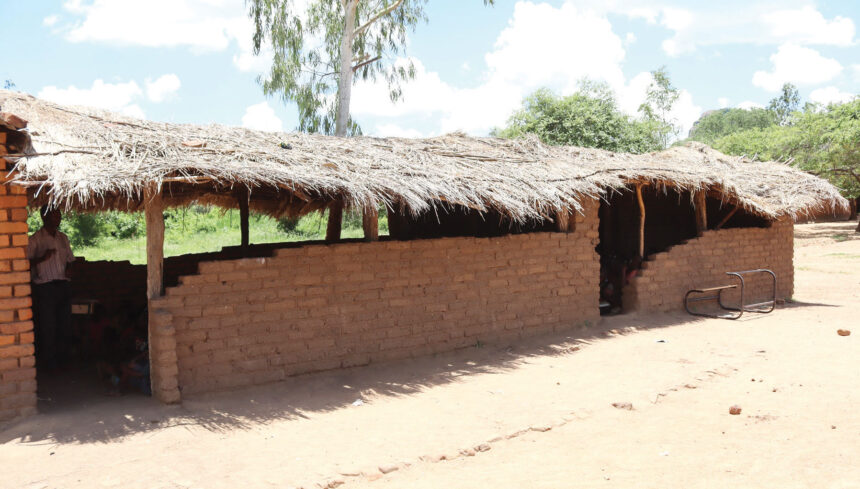
As Malawi strives to attain quality education for all as envisaged in Sustainable Development Goal (SDG) 4, some communities would see this as a far cry from their reality.
The goal seeks to ensure inclusive and equitable quality education and promote lifelong learning opportunities for all by 2030,
But with inadequate infrastructure, teachers and teaching and learning materials in most primary schools, Malawi has much to do to achieve this goal.
At Lusape Primary School, about 12 kilometres off the M5 Road in Traditional Authority Ganya in Ntcheu District, educating learners is a tough affair.
The school is also not accessible to dozens of children as it is hard to reach due to the poor condition of a road leading there and the flooding of Bwanje River during the rainy season.
- Advertisement -
The full primary school has one classroom block against 635 learners and, as a way of addressing the challenge, community members have erected sub-standard structures so that children do not learn under trees as they used to.
The school has one teacher’s house against eight teachers, which means the other seven have to rent houses at Sharpevalle which is several kilometres from the school.
Every time it rains heavily, classes are disrupted as the majority of lessons are conducted under the dilapidated structures. The learners are bundled up in a single block for safety.
Standard 8 learner Gift Wilson, 18, is losing hope of realising his dream of becoming a journalist, due to the difficult environment he learns under.
- Advertisement -
- Advertisement -
“When other learners flee their classrooms to my classroom during rain, learning obviously stops,” Gift says.
Another Standard 8 learner at the school, Bridget Nice, says when rain falls, teachers release them earlier so that they can cross Bwanje River before it floods.
“The teachers also have to leave quickly because most of them cross the river to get home. This affects us as we knock off before concluding the day’s lessons,” Bridget laments.
Willard Juwa from Hambahamba Village, whose two children learn at Lusape Primary School, wishes the learning environment at the school was better.
“We are asking government to help us with more school blocks. The first one we constructed as a community in 2004. We have also constructed another shed which is not very secure, but it is better for the children to learn under a structure,” Juwa narrates.
Head teacher for Lusape Primary School, Joseph Kakhome, echoes sentiments that the road to the school becomes impassable when it rains.
“Teachers are living far from the school because there are inadequate houses at the school and when there are heavy rains, they stay home. This is reflected in examination results,” Kakhome says.
People in communities around the school are unhappy with standards there.
But is there anything they can do to demand better developments from duty-bearers?
Some organisations are building the capacity of rural communities, who are usually helpless in such situations.
Through its Citizen Voice and Action project, World Vision Malawi is empowering people in rural areas to demand answers from duty-bearers on developments in their locations.
During one such interface at Bwanje in Ntcheu, the issue of Lusape Primary School came to light.
World Vision Malawi Associate Director of Programmes Takondwa Mwale said the project allows duty-bearers and community members to interface on a number of policy gaps using locally available resources.
Patricia Zidana, chairperson for Citizen Voice and Action for Bwanje, said they are concerned that children are not learning adequately due to shortage of teachers and school blocks.
“Many children are learning in shacks, while others are learning under trees. This is why we have called our duty-bearers so that they address our concerns so that our children learn in good environment,” Zidana said.
In response to such concerns, Deputy Minister of Education Nancy Chaola Mdooko said the ministry, with funding from the World Bank, is in the process of constructing 5,450 school blocks across the country, translating to 10,900 classrooms.
Chaola Mdooko said some schools around Bwanje are benefitting from the initiative.
However, for learners such as Bridget and Gift, the current problems are enough to blur their futures.
“I don’t think I will pass my examinations because I don’t bother to come to school when it rains. Sometimes I can’t cross the river when it floods as there is no bridge across it,” Bridget says.