By Mike Mataka:
In the flood-prone plains of Chikwawa District and the hilly terrains of Phalombe District, where natural disasters occur almost annually, a quiet revolution is taking place. What once were disaster zones are now becoming strongholds of resilience and hope, thanks to World Vision Malawi’s Integrated Resilience Project.
Since 2019, World Vision Malawi—with support from the World Food Programme (WFP) and the Government of Malawi—has been implementing the project in five traditional authorities (TAs) namely Maseya, Ngabu, Ngowe, Katunga and Makhuwira in Chikwawa and also in Phalombe District.
The goal is simple but ambitious—empower communities to become self-reliant, reduce dependency on aid and build resilience through sustainable agricultural practices.
The project promotes various farming techniques, including conservation agriculture, crop diversification, climate-smart methods, nutrition-sensitive agriculture, agroforestry and efficient irrigation.
- Advertisement -
Additionally, post-harvest management and animal husbandry are promoted while beekeeping clubs and goat rearing have given families additional sources of income.
In Msomo Village, under TA Ngabu, in Chikwawa, Group Village Head (GVH) Nsoma says the story of his community has changed dramatically.
Once at the mercy of floods, his village is now reaping the benefits of reforestation and water conservation structures.
“Floods used to wash away everything—homes, crops, even people’s hope, but now, every household plants at least five trees a year, and we have introduced bylaws to protect them.” Msomo said.
- Advertisement -
- Advertisement -
The village has also shared tree seedlings with surrounding communities to ensure everyone is moving forward together. Trees are being planted in all the areas that are disaster-prone to reduce the impact.
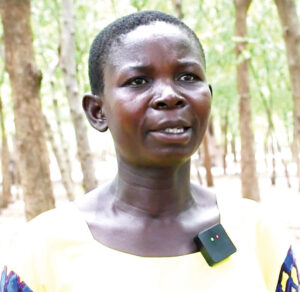
Loveness Lupinga from Chione Village, under the same TA, is one of the many people whose lives have been touched by the project.
When Cyclone Freddy struck in March 2023, her house and livestock were lost—but her life was spared.
“If it weren’t for the trees planted through this project, the water would have taken all of us. These trees blocked tree logs and debris. That’s what saved my children,” she said.
Now, she has vowed to plant more trees and care for them like her own children.
For Martha Stanley, another resident of Chione, the loss was painful—livestock, textbooks and children’s clothes were all washed away.
But she, too, is part of the new spirit of rebuilding.
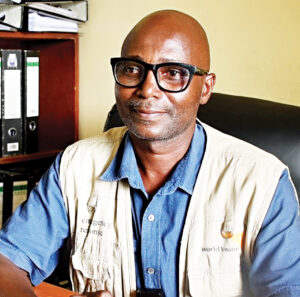
Mark Allan, World Vision Malawi’s District Programme Coordinator for Chikwawa, believes the true strength of the project lies in the hands of the people it serves. He says such deep-rooted community involvement is not just important—it’s the heartbeat of sustainability.
“The project is not something we are doing for the communities. It’s something we are doing with them. Every step involves locals’ participation because that’s how you build real, lasting change. We, as World Vision, believe that the power to change dwells in the communities; as such, involving them in every step of the project brings them closer to the project,” Allan said.
In Phalombe, the project has sparked transformative change—so significant that Sub-TA Nyambalo calls it a game changer.
“Our area is mountainous and used to be difficult for farming. But with the introduction of water trenches and stone banks through this project, everything has changed. Farmers are now harvesting more than ever, the water table has risen and, for the first time in years, farming here is not just possible—it’s dependable.” Nyambalo said.
Nyambalo said he and other traditional leaders in the district have gone as far as introducing community bylaws—not just as rules, but as a commitment to safeguarding the progress made. These bylaws are a collective promise to protect the land, preserve the environment and ensure that the gains made today do not vanish tomorrow but, instead, lay the foundation for a stronger and more resilient future.
The revitalised forest areas in Phalombe have created new opportunities beyond farming. The regrown trees around the mountain now support beekeeping, with farmers hanging hives from strong branches and harvesting honey that supplements household income. This side activity, made possible by the project’s environmental focus, has grown into a viable economic boost for many families.
At the same time, the shaded areas formed by the planted and regerminated trees have turned into unexpected study spots. Students from nearby schools, including Mpasa Secondary School, often gather under the canopy to revise lessons and study in groups.
The breeze, coupled with the quietness of the trees, has created a natural outdoor classroom where learning feels a little easier than before.
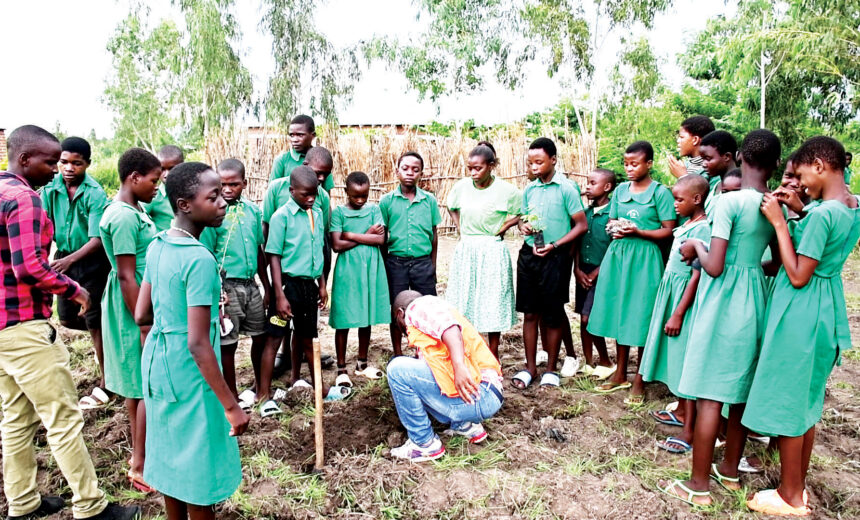
But perhaps one of the most powerful additions to the project in Phalombe lies in how it is shaping the next generation. At Chigawe Primary School in the area of Sub-TA Nyambalo, learners are not just witnesses to change—they are part of it.
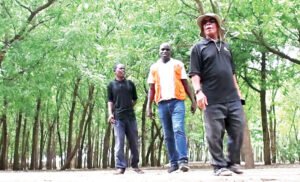
As one approaches the school, they are welcomed by rows of well-tended trees planted in neat lines, giving the entire school a vibrant and peaceful atmosphere. The sight itself speaks volumes about how deeply the learners value their environment.
Steve Mwangata, a teacher and patron of the Disaster Risk Management (DRM) club at the school, remembers the humble beginnings when World Vision helped establish the club in 2021.
“Back then, it was hard to convince learners to join. Now, the club is one of the most active at this school. When children understand their role in protecting the environment, they stop being passive observers and start becoming problem solvers. We are the witnesses here. We are not just growing trees here—we are ‘growing’ responsible citizens who will protect the future,” Mwangata says.
Through the club, learners are taught issues related to environmental conservation and climate change, equipping them with knowledge and practical skills they take back to their homes and communities.
Mwangata believes that this is vital in an area prone to natural disasters.
Standard eight learner Promise Buluzi is now one of the club’s most enthusiastic members, though she was not always convinced.
When the club was first introduced, she was hesitant, assuming it was just another routine school activity.
But after deciding to give it a chance, she quickly discovered it was much more—a space that equips learners with practical skills and knowledge, shaping them to face the future with confidence and purpose.
“Before I joined the club, I didn’t know what to do if there were floods or storms. Now I know the warning signs and how to stay safe. I have also learned how planting trees and protecting the land can help prevent disasters,” Promise said.
Promise believes the lessons gained through the club do not end when the school day does—they ripple out into the community, sparking change at home and beyond. What starts as classroom learning is now inspiring action in households, where students like her are becoming young ambassadors for the environment.
“We are not just learning for ourselves—we are teaching our families, our neighbours, even our younger siblings at home. We are planting trees, raising awareness and proving that age doesn’t matter when it comes to protecting our environment. We may be young but we are already making a difference,” Promise said with a smile.
The project does not end with tree planting and training. It also supports smallholder farmers with cash for asset creation, helping nearly 19,500 households in both districts.
Community members have benefitted from fruit orchards, solar pumps, irrigation schemes and environmental restoration structures such as deep trenches, swales and gully revegetation.
The initiative is aligned with Malawi’s Transforming Households Resilience in Vulnerable Environments programme that is being championed by World Vision. It is aimed at improving rural livelihoods and reducing poverty through long-term, community-driven development.
From the deeply eroded fields of Chikwawa to the rocky hills of Phalombe, the Integrated Resilience Project is changing the narrative. And while floods may still come, community members are no longer helpless. They are organised, informed and prepared.
As the sun rises over the fields of Chikwawa and the hills of Phalombe, it does not just shine on crops and trees—it shines on a renewed sense of purpose.
In communities once defined by disaster, resilience is now rooted in every furrow and forest line.