By Daniel Zimba:
It is 11:30 on a Tuesday morning, and by this time in Malawi, many children are scrambling through school gates while others relax within school compounds, enjoying their lunch breaks after hours of learning since around 8am.
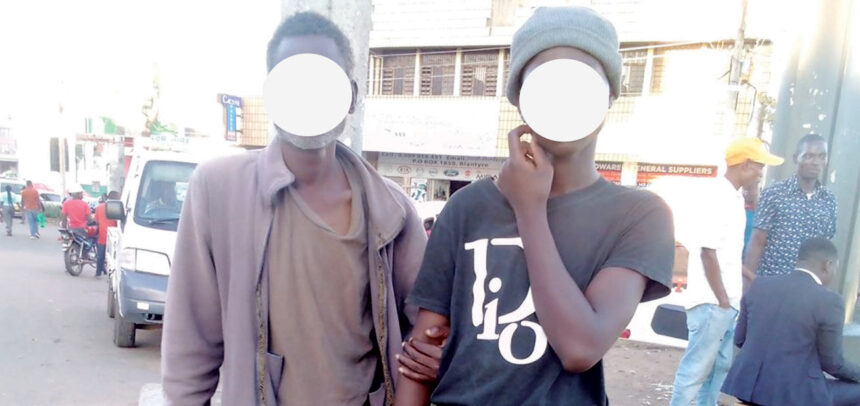
However, this is not the case for 15-year-old Hopeson, who stands by the roadside along Chipembere Highway in Blantyre, enduring the pain of an empty stomach.
He has no choice but to extend his hand for help from drivers or passers-by, standing beside his visually impaired father, Chinguwo, in the hope of receiving a morsel of kindness.
Instead of being a schoolboy like most of his age, Hopeson has become a guide for his father, who also has partial hearing loss, leading him to their designated begging spot.
- Advertisement -
As 44-year-old Chinguwo follows his son’s lead, the hardships etched onto their faces tell a story all too familiar in a nation grappling with poverty.
“Help us, we need food,” they call out, their voices heavy with desperation, as this reporter approaches.
The stark contrast between their lives and those of children heading to school is impossible to ignore.
Hopeson’s bright eyes still flicker with hope, although it dims with every car that passes them by.
- Advertisement -
- Advertisement -
“Without him, I would not be able to survive as I cannot work and I have six mouths to feed,” Chinguwo admits, his voice a mix of helplessness and regret.
The anguish in his voice is piercing—a father torn between the realities of his disability and the desire for a better future for his son.
“Poverty and my condition have forced us into this life. I feel such guilt knowing my child’s future is uncertain,” he says.
On another day, in the streets of Lilongwe, this reporter meets 13-year-old Grace, in a similar situation.
Grace reportedly dropped out in Standard Six and now begs for food while guiding her visually impaired mother.
“I know staying on the streets is not safe for me, but how can I learn when my stomach growls with hunger?” she laments.
When asked about their situation, Grace’s mother, Rose, weeps openly, overwhelmed by the weight of poverty.
“I never wanted to live like this with my child, but circumstances have left us no choice,” she whispers through her sobs.
“I wish to see my daughter in school building a future better than mine. If only I had the means to start a small business, we would not have to beg,” Rose adds.
She reveals that her husband abandoned her and married another woman, and that with no other source of income and her condition, it is difficult to work.
These are just two of many stories of children enduring burdens far beyond their years on the streets of Malawi.
On April 22, 2025, First Lady Monica Chakwera acknowledged that Malawi is home to 15,000 street-connected children, of whom 6,000 are girls.
She made the remarks after hosting street-connected children at Kamuzu Palace in Lilongwe, in commemoration of the International Day of Street Children, observed annually on May 22.
The First Lady, who is also founder of the Shaping Our Future Foundation, commended efforts by the Ministry of Gender, Community Development and Social Welfare as well as various civil society organisations (CSOs) to transform the lives of street-connected children.
According to the ministry’s spokesperson, Pauline Kaude, special funds have been set aside to support people with disabilities.
“Poverty is a deciding factor for parents who resort to begging in the streets. The government has registered parents who are escorted by their children to beg, and they are being supported through the City Urban Cash Intervention to help reduce this burden,” Kaude said.
However, The Daily Times has found that many people targeted by such initiatives, including Rose and Chinguwo, remain unaware of these opportunities.
Malawi 2063, the country’s long-term development blueprint, aims to promote inclusive growth, including in education.
The Education Act of 2013 mandates compulsory education for children under 18, but for Hopeson, Grace and many others, this remains out of reach.

Civil Society Education Coalition Executive Director Benedicto Kondowe has expressed concern over what he calls the government’s lack of commitment and political will to implement the Act effectively.
Kondowe believes compulsory primary education is key to tackling illiteracy and reducing the number of children forced onto the streets to beg.
While acknowledging progress in increasing primary and secondary school enrolments, he insists there is still a long way to go to ensure compulsory and inclusive education in Malawi.
“As much as we have the 2013 Act of Parliament which provides for compulsory primary education, we have not taken steps to actualise it,” he says.
A local child rights organisation, Eye of the Child, has since called on the government to ensure that the Social Cash Transfer Programme truly benefits families of street-connected children.
The organisation’s Communications Officer, Asiyatu James, says: “Children deserve the right to education just like any other child.”
However, James notes that some CSOs prioritise their own interests over the wellbeing of these children, compromising efforts to address the situation.
In the meantime, it remains clear that if current trends continue, future generations risk being trapped in chronic poverty, their dreams stifled before they begin.
Section 23 of the Child Care, Protection and Justice Act, as well as the Criminal Code, prohibit begging by both adults and children in public spaces.
Yet poverty is pushing scores of children out of schools and homes onto the streets to seek alms to survive, some doing it for their parents.