The Reserve Bank of Malawi (RBM) says the broader inflation environment remains delicate, shaped by structural vulnerabilities to external shocks.
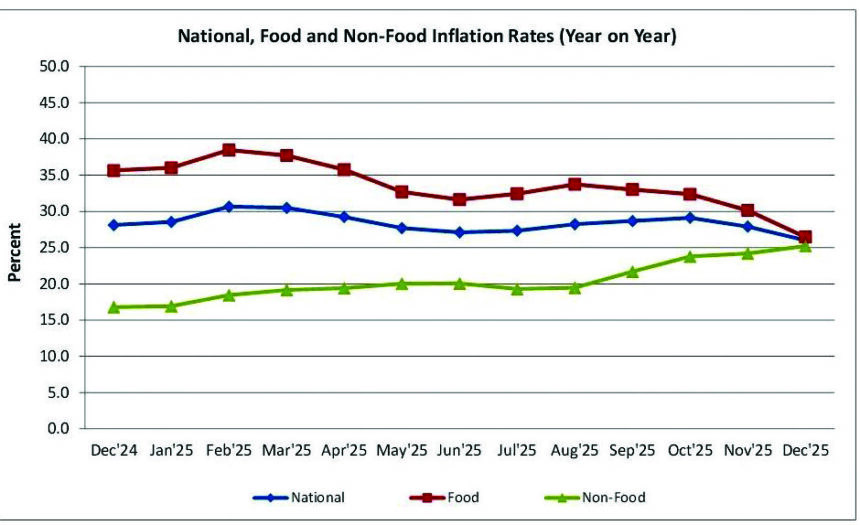
In its December 2025 Market Intelligence Report published on Wednesday, the central bank says the continued decline in food inflation is offering relief, easing headline pressures and cushioning households.
However, RBM noted that non-food inflation remains elevated, posing underlying risks.
“The uptick in non-food inflation reflects underlying risks, even as kwacha stability helps to anchor inflation expectations,” the report reads.
Headline inflation eased for the second consecutive month at the close of the year, falling to 26 percent in December 2025 from 27.9 percent in November, largely due to slowing food inflation.
- Advertisement -
Food inflation declined to 25.5 percent in December from 30.1 percent in November and 32.4 percent in October.
Regionally, the sub-Saharan Africa (SSA) region recorded mixed inflation trends in December 2025 but Malawi remains among the highest, according to RBM.
In neighbouring Zambia, headline inflation rose slightly to 11.2 percent from 10.9 percent in November but remained far below Malawi’s 26 percent.
Botswana registered a marginal increase to 3.9 percent from 3.8 percent, attributed to higher transport and health costs, while food inflation eased.
- Advertisement -
- Advertisement -
Meanwhile, Tanzania’s headline inflation edged up to 3.6 percent from 3.4 percent in the preceding month, driven mainly by food prices.
RBM further observes that global conditions at the close of 2025 pointed to an economy adjusting to disinflation, uneven commodity markets and divergent monetary policy responses.
“Going forward, sustained vigilance and coordinated policy action will be required to consolidate recent gains, mitigate vulnerabilities and preserve macroeconomic stability. The priority remains sustaining the disinflation process and accelerating economic recovery,” the report indicates.
In an interview, economist Marvin Banda said sustained disinflation would require coordinated policy interventions targeting both food and non-food components.
“Macroeconomic fundamentals are beginning to reflect stability. Inflation may slow if food production improves but living costs are unlikely to fall unless other prices also decline,” Banda said.
Inflation averaged 28.4 percent in 2025, down from 32.2 percent in 2024.
Meanwhile, the central bank has maintained a tightened monetary stance, keeping the policy rate at 26 percent throughout the year, to tame inflation.
In 2026, the Economist Intelligence Unit (EIU) projects inflation to average 27.6 percent, while the World Bank forecasts a similar trajectory. However, Finance, Economic Planning and Decentralisation Minister Joseph Mwanamvekha has expressed optimism that inflation will continue declining in 2026, citing improved maize availability and controlled government expenditure as key drivers.
Speaking during a recent pre-budget consultation meeting in Blantyre, Mwanamvekha said both food and non-food inflation have shown a downward trajectory since September 2025, with maize prices expected to drop further due to adequate stocks in the country.
“Inflation has been coming down since September last year and it will continue coming down because of a number of factors. When you control expenditure, you are controlling inflation, particularly non-food inflation. On food inflation, we have enough maize in Malawi now. We have bought a lot of maize—200,000 metric tonnes [from Zambia]—and even when people are harvesting, we will still have maize because it’s a lot.
“Our inflation is more influenced by food and when I’m talking about food, I’m talking about maize. You address the issue of maize, you are addressing [the problem of] inflation. If we have enough maize this coming year, we’re not going to import and, therefore, we’re going to save on foreign exchange. That’s why we are projecting that the macroeconomic fundamentals will be right,” Mwanamvekha said.