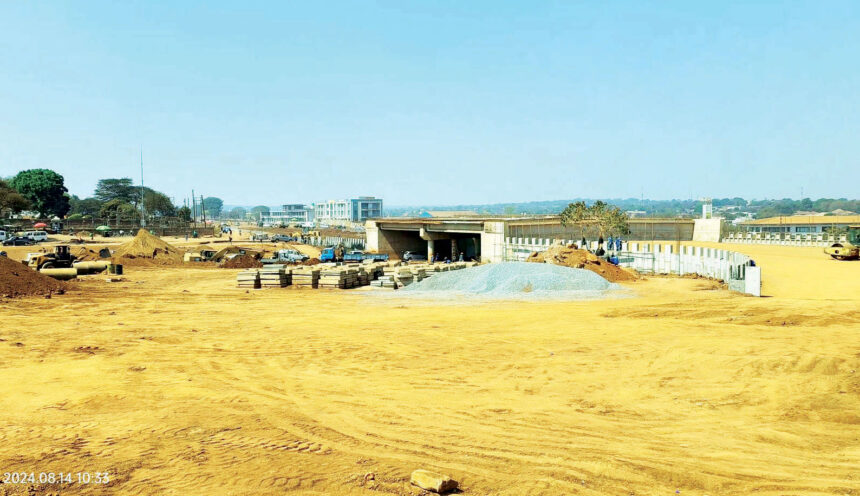

At 7am, Gibson Millison begins his illegal sale of second-hand clothes along Kenyatta Six-Lane and Mzimba streets in Lilongwe.
He has been running this business for a year, ever since construction began on the roads.
“I have been selling second-hand clothes here for a year and I have witnessed the entire road construction process.
“It is exciting to see Lilongwe City changing its appearance. We needed these developments 50 years ago,” Millison says.
He is, however, concerned that once the road is completed, he will have no further opportunities to continue his business.
- Advertisement -
Lilongwe City Mayor Elise Sagawa is optimistic about the new infrastructure improvements and construction projects.
She believes these developments will enhance public spaces and provide better services for residents.
Sagawa attributes the transformation to a combination of government initiatives, private investments and international aid aimed at urban development and improving the quality of life in the city.
Economic commentator Velli Nyirongo agrees that Lilongwe is undergoing a positive transformation.
- Advertisement -
- Advertisement -
He notes that recent investments in infrastructure, the economy and culture are long overdue and reflect the city’s ambition to become a leading regional hub.
“While progress is commendable, there is still work to be done. To reach its full potential, Lilongwe needs a well-thought-out plan that balances growth with sustainability, fairness and resilience.
“This includes improvements in public transport, green spaces and disaster protection,” Nyirongo says.
He emphasises the importance of investing in education, healthcare and job skills for a thriving city. A healthy and skilled population is crucial, he adds.
Nyirongo also highlights the need for good governance and accountability to attract investment and build public trust.
“Tackling corruption and improving public services are essential for success. Embracing technology is also vital for Lilongwe’s future,” he says.
From its origins as a small colonial settlement, Lilongwe is evolving into a vibrant urban centre, reflecting its aspirations for modernity and progress.
The city’s skyline is transforming with the construction of new buildings, commercial centres and residential complexes.
The Kenyatta Six-Lane Road expansion project, for instance, is progressing, including the construction of a new interchange.
The expansion of key roads and highways is expected to enhance connectivity within the city and to other regions, easing traffic congestion and stimulating economic activity by facilitating the movement of goods and people.

Director General of the National Planning Commission of Malawi, Thomas Munthali, notes that Lilongwe’s economic landscape is also changing.
He says the city is emerging as a hub for business and investment, attracting both local and international entrepreneurs.
“The creation of special economic zones and industrial parks is fostering a conducive environment for manufacturing and other industries.
“This, in turn, is generating employment opportunities and contributing to the city’s economic growth,” Munthali says.
He adds that the expansion of the financial sector, with new banks and microfinance institutions, will provide residents with better access to credit and investment opportunities, further fuelling economic development.
Despite embracing modernity, Lilongwe remains deeply connected to its cultural heritage. Various initiatives and institutions celebrate Malawi’s rich traditions.
For instance, the Lilongwe Cultural Centre hosts exhibitions, performances and workshops showcasing the country’s art, music and dance.
The annual Lake of Stars Festival, though primarily held on the shores of Lake Malawi, also infuses Lilongwe with a vibrant cultural atmosphere, attracting artists and visitors from around the world and promoting cultural exchange.
As Lilongwe grows, there is a conscious effort to integrate green spaces and sustainable practices into its development.
Parks and recreational areas, such as the Lilongwe Wildlife Centre and the newly renovated Area 18 Park, offer residents spaces for relaxation and leisure.
Environmental sustainability initiatives, including waste management, renewable energy and water conservation programmes, are being implemented to ensure that Lilongwe’s growth does not compromise its natural resources.
As Lilongwe evolves, it stands as a beacon of progress and possibility in Malawi.
The new face of the city is not just about modern buildings and economic growth; it is about creating a city that enhances the quality of life for its residents while preserving its unique cultural identity.
In the coming years, Lilongwe is set to further establish itself as a dynamic and forward-looking capital, guiding Malawi towards a future filled with promise and opportunity.