




By Loveness Lega
From a distance, Kaning’ina Forest, which straddles Mzuzu City and Nkhata Bay District, appears green and dense, a continuous canopy that suggests peace and life. Yet a few steps inside reveal a starkly different reality.
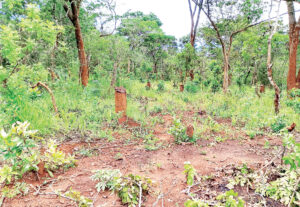
What looks like a thriving forest is, in truth, under sustained pressure.
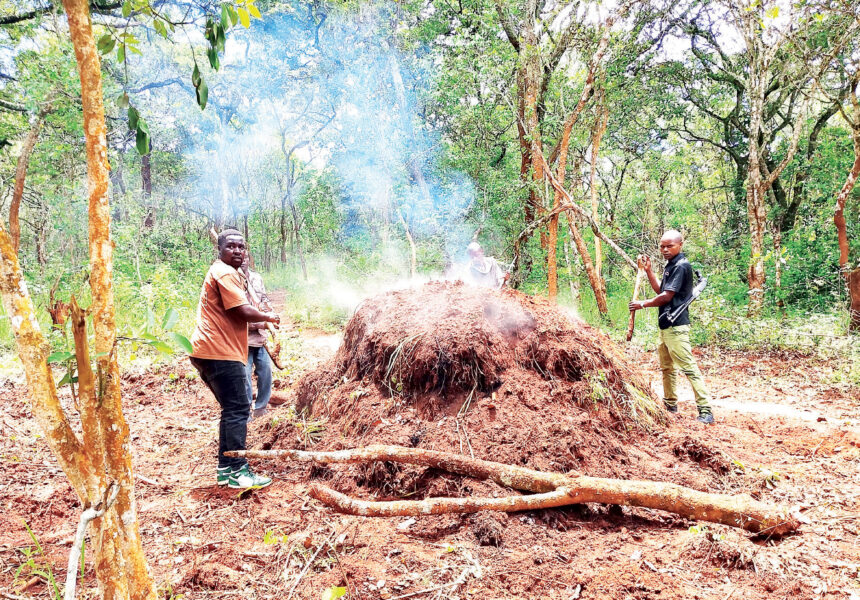
Loggers and charcoal producers move in and out of the reserve with urgency, cutting and burning in a race against time to extract what remains of the standing timber.
Driven largely by poverty and limited livelihood options, they are steadily eroding the forest’s remaining cover.
- Advertisement -
The ecosystem that once helped regulate rainfall patterns, maintain cooler temperatures and reinforce Mzuzu’s identity as Malawi’s green city is gradually weakening.
On a recent Tuesday, we joined a fact-finding mission to assess the scale of environmental degradation and to observe ongoing conservation efforts.
Our first stop was the forestry office, where officers accompanied us for security as we entered the forest, which was first gazetted in 1935 and remains one of the key protected forest reserves in northern Malawi.
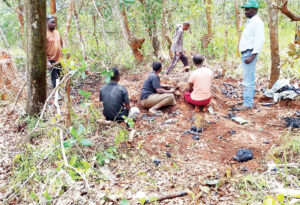
Barely 100 metres from the office, we encountered groups of loggers and charcoal burners moving briskly between the forest edge and deeper thickets.
- Advertisement -
- Advertisement -
Their presence so close to the station illustrated both the intensity of pressure on the reserve and the difficulty of controlling access.
As we moved further inside, tensions escalated. Forestry officers suddenly spotted suspected charcoal burners and immediately jumped from the vehicle in pursuit. A brief chase followed through uneven terrain before the suspects disappeared into the forest.
According to the officers, such incidents are common during patrols.
“This is what happens almost every time we conduct patrols. Unfortunately, we cannot do this regularly due to resource constraints,” one officer said.
At the time of the visit in March, the forestry office had not received fuel supplies since December, effectively grounding routine patrols for several months.
Without transport, monitoring becomes sporadic and illegal activities continue with limited resistance.
Kaning’ina Forest covers approximately 16,657 hectares and plays an important ecological role as a catchment area feeding several rivers.
These rivers support rural piped water schemes, crop irrigation systems and other downstream uses that depend on consistent water flow and reduced sedimentation.

Forestry Communications and Advisory Services Officer for the Northern Region, Kelvin Chisaka, acknowledged the extent of the degradation and the operational challenges facing the department.
Chisaka said that although the mandate to protect the forest is clear, enforcement is constrained by inadequate resources, particularly in relation to patrol logistics and staffing.
The northern zone has 22 forest guards against a required establishment of 46. Only six of these officers are armed, limiting their ability to confront organised illegal activity in remote areas.
“Our expectation is that environmental crimes should be treated as serious offences in the country and we expect collaboration among stakeholders,” Chisaka said.
He added that while tree planting campaigns are widely implemented across the region, many lack proper follow up and maintenance. This results in low survival rates and limited long term impact.
“Many stakeholders plant trees but do not follow up on their survival. As a result, the survival rate is very low,” he said.
Across Malawi, deforestation remains a persistent challenge. The country is estimated to lose between 33,000 and 42,000 hectares of forest each year due to agricultural expansion, charcoal production and unsustainable timber harvesting.
This continues despite Malawi having more than 90 protected areas, including national parks, wildlife reserves and forest reserves.
In Kaning’ina, the implications of continued degradation extend beyond biodiversity loss. The forest is a critical water catchment area linked to Lunyangwa Dam, which supplies water to parts of Mzuzu and surrounding communities.
The Northern Region Water Board, which manages the dam, says it is taking preventive measures to protect the catchment area from further damage.
A recent bathymetric survey shows that Lunyangwa Dam has not yet experienced significant siltation. However, officials caution that continued deforestation upstream could accelerate sediment build up in future.
Since 1998, the board has planted an average of 100,000 tree seedlings annually in efforts to restore vegetation cover around the catchment. These efforts aim to stabilise soils, reduce erosion and maintain water quality.

Chief Operations Officer for the Northern Region Water Board, Asumani Ungwe, said the institution is combining enforcement with community engagement to address the problem.
“We want to work with the communities so that we regulate how they access the forest and this will empower them to start using alternative energy,” he said.
Lunyangwa Dam has a storage capacity of approximately 4.3 million cubic metres of water. Experts warn that if siltation increases due to ongoing deforestation, the dam’s effective capacity could be reduced, affecting water supply reliability for urban and peri urban users.
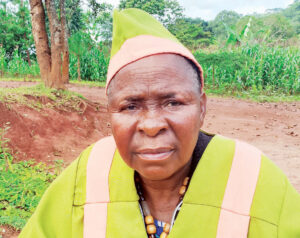
Despite these interventions, concerns remain among some traditional leaders. Traditional Authority Thula attributes part of the problem to weak enforcement structures and alleged corruption within the forestry system.
She claims that some officials are involved in illegal timber trade, which undermines conservation efforts and makes regulation more difficult.
She also argues that population pressure from outside the immediate area contributes significantly to forest loss.
“It is better to expand Mzuzu with some infrastructural developments so that we only have Kaning’ina Forest to secure,” Thula said.
Her remarks reflect a broader debate about urban expansion, land use planning and conservation priorities in fast growing cities.
Environmental commentator Charles Bakolo has proposed the establishment of a joint forest management committee to improve oversight of Kaning’ina Forest.
Bakolo said the committee should include civil society organisations, the forestry department, traditional leaders and community representatives to ensure shared responsibility.
“There must be engagement of local leadership as well as empowerment of communities so that they take action in conserving the forest because many people think the responsibility rests only with leaders and forest guards,” he said.
His proposal aligns with wider conservation approaches that emphasise community based natural resource management, which has been adopted in various forms across southern Africa to improve compliance and local stewardship.
Malawi continues to face a structural tension between environmental protection and immediate livelihood needs.
Charcoal remains a primary energy source for many households due to limited access to affordable alternatives. This demand continues to drive illegal production even within protected forest reserves.
Recent legal reforms, including the Forest Amendment Act of 2025, aim to strengthen enforcement and improve coordination among institutions responsible for environmental protection.
The amended law broadens the definition of enforcement officers to include personnel from the Malawi Police Service, Malawi Defence Force, Road Traffic and Safety Services, National Parks and Wildlife, Fisheries, the Malawi Revenue Authority, Immigration and the Malawi Environmental Protection Authority.
It also grants officers expanded powers to inspect, arrest and detain suspects and to seize forest produce and equipment without a warrant where there are reasonable grounds to suspect an offence.
Authorities hope the reforms will improve deterrence and reduce illegal logging and charcoal production.
However, as the situation in Kaning’ina Forest shows, enforcement capacity, resource constraints and community dependence on forest resources remain major challenges.