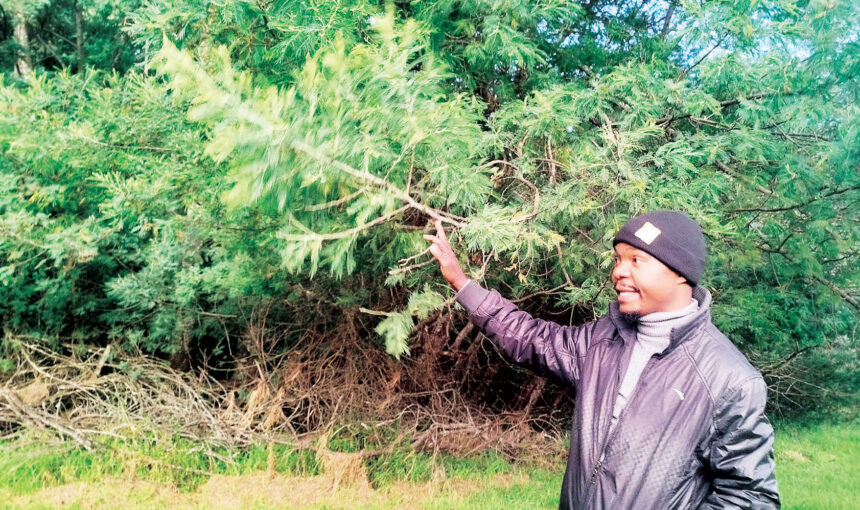
In 1958, some people who were living on Nyika Plateau could not keep up with heavy winds such that they decided to have a plantation to act as a windbreak.
Trees such as pine, blue gum and black wattle were introduced to the plateau.
At the time, about 250 hectares (ha) of pine were planted but over the years, they have grown to over 500ha. Consequently, they have become invasive, harming plants and animals.
Senior Research Officer for Nyika National Park Edson Sichali fears that if no action is taken against the invasive alien species (IAS), other species, particularly native breeds, will disappear.
“You will not see any other plant growing and this means the animals will have nothing to feed on,” Sichali says.
- Advertisement -
He adds that at one point, the park’s management engaged some people to cut down pine trees in the reserve but they breached a contract and were told to stop.
That time, about 230ha of pine were removed but seed was left behind in the soil and germinated to produce more pine trees.
Sichali says the park did a study to find at a lasting solution to IAS.
“We engaged in debarking the pine and continued with the cutting down of the trees because we thought it was effective.
- Advertisement -
- Advertisement -
“On black wattle, we were cutting down the trees and applying some chemicals. Now after monitoring, we found that the roots were still effective but when we uprooted them, the trees were gone.
“The study did not go far because animals were grazing on the same land,” he explains.
He says all the methods need money, which is not always there.
Sichali’s concerns coincide with the conclusion of a five-year pilot project on IAS management.
Boniface Chimwaza, Chief Environmental Officer in the Ministry of Natural Resources and Climate Change, says, so far, 500ha of self-sown pine are being cleared in Nyika and Mulanje Mountain.
Chimwaza says about 111ha of land in Mulanje and Nyika have also been restored with native trees.
“Pines are very important in other aspects but when they are found in places that are protected, they cause problems. So, as a project, we thought that we should concentrate on protected areas,” he says.
Chimwaza says despite efforts that have been made over the past five years, IAS is still a concern as they only concentrated on three alien species even though there are others such as bracken fern, which are spreading and taking up grazing land.
“We have developed a strategy and action plans that will be implemented after the phasing out of the project. We have a communication strategy which will help how we can spread the messages to do with the management of IAS.
“We are also trying to make sure that concerned government departments and other stakeholders internalise the activities we have been doing such as the removal of the invasives,” he explains.

Meanwhile, Samantha Nampuntha, Campaigns Manager for Lilongwe Wildlife Trust, whose organisation was part of the project, hopes the gains that have been made will be sustained.
“We were tasked to help in raising awareness on IAS and we have been creating materials to inform people about this.
So, we are still incorporating ways that can be used to sustain the messages even though the project is concluding.
“One such tool is a module on IAS that is being created and will be used in schools so that students are aware at tender ages,” she said.
Funded by the Global Environment Fund, the IAS management project was being done by various organisations including Total Land Care, which says 47.1ha of land adjacent to protected areas of Nyika and Mulanje has been cleared of IAS.
The project was being Implemented by the United Nations Environment Programme and the executing agency was the Department of Environmental Affairs and 11 others.
Nyika National Park is the largest of Malawi’s five national parks.
The central feature of the park, the Nyika Plateau, was formally declared Malawi’s first national park in 1965.
The park was expanded in 1978 and covers an area of 3,134 square kilometres in northern Malawi.
It lies astride the Chitipa, Karonga and Rumphi districts of the Northern Region.
Part of its western boundary is the Malawi-Zambia border, adjoining a section of the Zambian Nyika National Park.