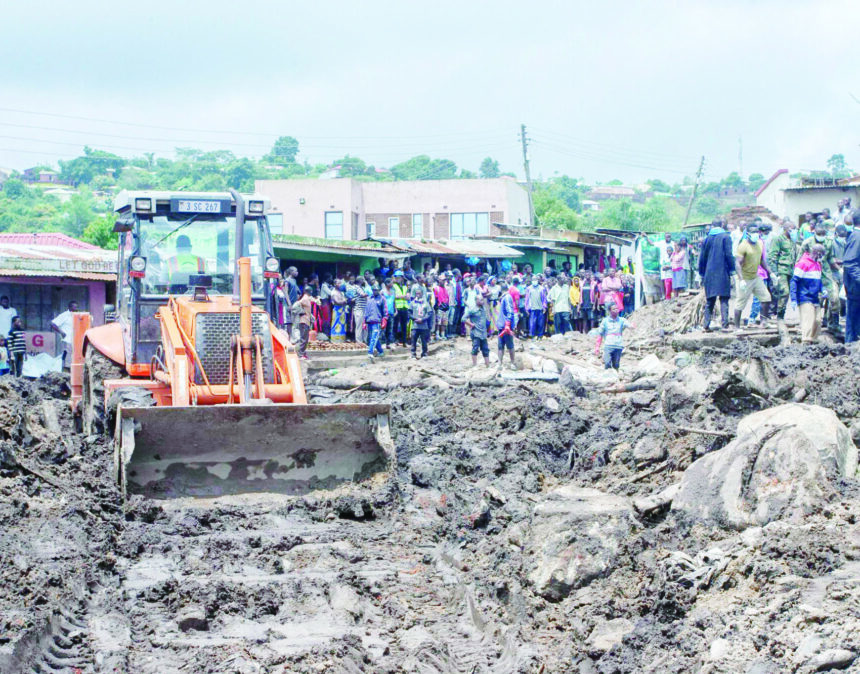
The scent of damp earth still clings to Mariam Yusuf’s memories, two years after Tropical Cyclone Freddy ripped through Malawi.
At 56, Yusuf, originally from Mulanje District, survived the cataclysm on Soche Hill, but the storm claimed her two homes and left her family injured and adrift.
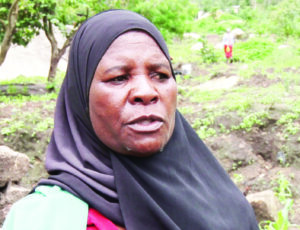
She still lives in the same dangerous place, Soche Hill.
“On that day, I was inside my house with my family and then we heard a loud sound of something falling and being dragged from uphill,” Yusuf recalls, her voice still holding a tremor.
“We quickly rushed outside, only to find ourselves caught up in hot mud flowing down the hill. I froze.”
- Advertisement -
The trauma remains etched in her mind. “I lost my senses at that moment, until someone from my neighbourhood came to rescue me by holding my hand and screaming loudly, ‘Let’s rush uphill!’ Then I regained consciousness and started running with her.”
Yusuf’s family had called Soche Hill home for over three decades, but the cyclone struck a double blow.
Her ancestral village in Mulanje was also obliterated. Now she feels trapped.
“We are still here at Soche Hill, we have nowhere to go. At least we own this plot, but rentals down the hill are very expensive and we cannot afford them,” she explains.
- Advertisement -
- Advertisement -
Yusuf remembers a recent night when it was raining while she was asleep. She heard the sound of water flowing outside and thought it was another disaster.
“I woke up and rushed outside, screaming loudly, ‘Madzi!’ meaning ‘Water!’ Only to be corrected by someone from my neighbourhood that it was a mere hallucination,” she recounts, her eyes welling up.
A 30-year-old Georgina Kaitano from Mpemba Township in Blantyre shares a similar harrowing tale.
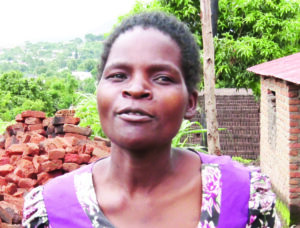
She lost two children and her baby sustained an eye injury in the same deluge.
“After hearing a strange sound, my three children and I, including a baby, came out of the house and then we were caught up in very hot mud flowing down the hill at high speed.
“The next thing I remember is that I was admitted to Queen Elizabeth Central Hospital with the baby, whose right eye was injured,” she says.
Life since then has been an uphill battle. Unable to afford rent, Kaitano and her surviving child grapple with poverty and the lingering trauma of the tragedy.
Both Yusuf and Kaitano yearn for relocation, but without support they remain tethered to the very place that nearly became their tomb.
Climate scientist Lucy Mtilatila, who heads the Department of Climate Change and Meteorological
Services, says current weather patterns predict continued occurrences of tropical cyclones similar to Freddy.
This, Mtilatila notes, underscores the need to strengthen disaster preparedness.
“With global warming, temperatures that cause tropical cyclones are still increasing and the possibility of other cyclones of similar magnitude to Freddy in the future remains very high,” she says.
She adds that Malawi still lags behind in disaster preparedness, despite having key laws such as the Disaster Risk Management Act of 2023, and reiterates the need to ensure effective implementation of related laws and policies.
“Right now, what we need to do is invest more in the implementation of the law, which guides issues of settlements, risk management and risk assessment, while making sure we are guided by science so that we are resilient enough to withstand such cyclones,” Mtilatila adds.
Soche Hill, however, is more than just a site of tragedy. It is a government-protected forest reserve.
Traditional Authority (TA) Kapeni, whose jurisdiction includes Soche Hill, points fingers at both the government and residents.
“People must take responsibility for their own safety. They experienced the cyclone, yet many remain in the same dangerous places, expecting the government to solve all their problems and even compensate them. While we understand their plight, self-preservation is paramount,” the chief says.
Kapeni, now in his advanced years, recalls a time in his youth when government officials actively protected the forest, making encroachment nearly impossible.
“The government showed seriousness in preventing citizens from encroaching on the area, which is also considered a danger zone for natural disasters,” he says.
He questions the current laxity, where authorities watch people construct houses without taking action.
“Many people have constructed houses in that government-protected space. Do you think none of the authorities knew people were constructing there? Why did they not intervene and stop the construction and encroachment all along?” the TA queries.
Environmental analyst Mathews Malata shares concern over the encroachment situation in Malawi.
Malata notes confusion among government agencies and offices in attempts to evict and discourage people from encroaching on protected land, which he says is undermining efforts to keep people away from such places and other disaster-prone areas.
“It is important for government ministries, departments and agencies to speak the same language if we are to address encroachments.
“You find that while the council prohibits people from building in protected areas, other social service providers continue supplying services in the same prohibited places, which compromises other efforts,” Malata says.
He supports calls to strengthen the implementation and compliance of disaster risk management laws and policies, urging the government, through the ministries of lands and local government, to consider declaring places such as Soche Hill high-risk areas and to help residents find new places of residence urgently.
“According to section 32 of the Disaster Risk Management Act, the responsible minister is mandated to declare areas of high risk and provide that people vacate those places within 30 days. The government should then move quickly to help people find new places of residence,” Malata says.
Efforts to relocate people from Soche Hill have stalled for years.
For example, in December 2017 the then vice president, Saulos Chilima, asked Blantyre City Council to vacate a five-year-old injunction obtained by people who had encroached on the hill with immediate effect.
Chilima questioned why the council was failing to do so despite having a fully fledged legal team.
In the immediate aftermath of the cyclone, the government pledged to relocate survivors to Mapanga in Blantyre, roughly five to ten kilometres from Soche Hill.
Nearly two years on, however, the promise remains unfulfilled and entangled in land disputes.
Costly Chanza, Blantyre City Council’s Director of Planning, initially stated that feasibility studies for Mapanga would be completed by November 2025.
However, recent inquiries were met with a referral to the council’s land surveyor, Amos Kadyalunda, who in turn redirected the matter back to Chanza’s office, highlighting a bureaucratic maze.
Meanwhile, the proposed relocation site at Mapanga is currently occupied by communities who claim ancestral ownership and resist relinquishing the land.
Dafuleni Mafukeni, 49, chairperson of the group benefiting from the Mapanga plots, asserts: “Our ancestors were given that land in compensation after serving James Nickon as labourers on his Mapanga Estates for years.”
Backed by 15 traditional leaders, Mafukeni adds: “We are surprised to hear that the government plans to give the land to the people of Soche. Where will we go then?”
He also refutes claims that the council engaged Mapanga communities over the proposed relocation.
The predicament mirrors a broader national challenge, where most government-protected areas continue to be encroached upon while responsible authorities appear to watch from a distance.
Many disaster-prone areas also remain inhabited despite repeated warnings.
While the need to relocate cyclone survivors is undeniable, the practicalities remain complex, leaving survivors like Yusuf and Kaitano suspended between the haunting memories of disaster and an uncertain future.