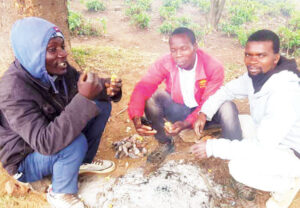
fire
Most pavements along the streets of Limbe Town in Blantyre are empty on a cold Thursday morning.
Vendors who often swarm the sidewalks with their merchandise have retreated to shops’ verandas to partly escape the town’s chilly weather.
On a typical mid- July afternoon, Limbe is a bright and warm commercial town teeming with shoppers and traders.
“This year, things are different,” Paikene Andiwochi, a motorcycle taxi rider, who ferries passengers from various locations in the town’s neighbourhood, says.
Andiwochi claims business has slowed down ever since the cold weather returned late last month after an oddly hot June which the Department of Climate Change and Meteorological Services (DCCMS) attributed to climate change.
- Advertisement -
At the time of our interaction, he was in the company of two fellow motorcycle taxi riders sitting around an open fire under a tree in a location outside Limbe.
They all claimed that the cold weather was keeping their customers away and that their incomes had significantly declined after the onset of the cold weather.
“It could be because authorities are urging everyone to be extra cautious and always keep warm. Some people would rather stay indoors if they have nothing to do outside their homes,” Andiwochi says.
Across Malawi, extreme weather appears to be becoming the new normal.
- Advertisement -
- Advertisement -
There is always some change in weather events from season to season— occurrences which experts say have not spared any part of the world.
Scientists posit that human activity is causing rapid changes to global climate that in turn trigger extreme weather conditions often in the form of heatwaves, strong winds and cold snaps.
Last year, a higher-than-normal hot spell persisted in Malawi, prompting DCCMS to advise people to drink plenty of fluids such as water, lower-fat milks and tea and coffee and avoid alcohol to stay well dehydrated.
Meteorological experts attributed the unusual conditions to the presence of a weather phenomenon known as El Niño.
This is a weather pattern that occurs when warm water accumulates in the central and eastern Pacific Ocean.
“This accumulation leads to significant alterations in global weather patterns, affecting various regions across the globe.
“Malawi is currently feeling the effects of this phenomenon, with changes in temperature and disruptions to rainfall patterns,” the World Bank said on its Climate Change Knowledge Portal.
In the wake of the current cold weather, DCCMS has been issuing cautionary alerts, urging everyone in the country to wear tightly woven coats or jackets, mittens, hats, scarves and waterproof boots to keep warm.
“Expect Chiperoni weather characterised by mostly cold, windy and cloudy conditions to persist, coupled with fog and rain drizzles, tonight and in the morning,” DCCMS said in its Wednesday’s weather bulletin.
Environmental and climate change activist Sinthani Mwase is worried that despite Malawi emitting one of the lowest amounts of greenhouse gases, it cannot be spared the impacts of climate change.
Mwase believes a forceful collective push by “innocent victims of climate change” could compel huger emitters to pay up for the chaos they are creating.
“At last year’s Conference of the Parties in Egypt, delegates agreed to establish a loss and damage fund through which developed nations are supposed to compensate poor countries like Malawi for the damage brought about by climate change.
“But the creation of the fund itself is not enough if the pace to phase out fossil fuels remains awfully slow,” he says.
Such observations are often outside the understanding of local-level victims of climate change who bear the biggest brunt.
They are not interested in the technical aspects of climate change but the support that can flow their way to mitigate the impacts of disasters caused by erratic weather patterns.
“That is why we must spend lesser time discussing the technical issues and more time considering the lived experiences of climate change victims. They deserve practical justice,” Mwase says.
Last month, DCCMS said the unusual weather condition being experienced across the country was a result of warming in the ocean.
This was after May and June, which are typically cold months in Malawi, elapsed without the condition being felt in earnest.
“The warming in the ocean, as a result of climate change, has also affected patterns of weather systems we experience in June in the country.
“Previously, we used to have high pressure systems in the southern part of South Africa and the Indian Ocean, which have not been very strong this year,” DCCMS Deputy Director Charles Vanya said.
Vanya added that the ocean waters were very warm to the extent that the pressure passing over southern Africa was too weak to push for cold weather conditions typically experienced in the month.
He indicated the changes could become the norm in the coming years.
“Climate is changing and what should be anticipated is that weather conditions will not remain the same. So these changes will be happening every year and next time we can expect a very cold June,” Vanya said.
While there are no recorded cases of anyone suffering from the impacts of the current cold weather, health experts state that such conditions increase the risk of illness and death from coughs, lung and heart problems and carbon monoxide poisoning from poorly maintained heating appliances.
Mwase argues that with the impacts of climate change becoming more pronounced from season to season, there must be more research on how people’s health is also affected.
“Perhaps, that would hasten efforts to mitigate the challenges climate change brings about,” he says.