By Elia Chibwe:
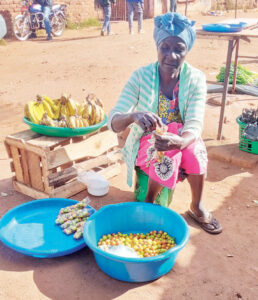
The life of single mother Hawa John, 60, has been filled with ups and downs.
Born in Chesomba Village, Traditional Authority (TA) Chalazi in Mangochi, John has six children whom she failed to educate after her husband died seven years ago.
Misfortunes overshadowed her happiness as all responsibilities fell on her shoulders.
Constantly worried about feeding her children, she started a small-scale business at Kawale Market in Lilongwe with the little money she had.
- Advertisement -
The profit from selling sugarcane and fruits helped her buy maize flour and relish for each day.
However, her business struggles intensified when the country’s currency was devalued in 2023, leaving her unable to find the required capital for the venture.
She was lost until the Price Shock Emergency Urban Cash Transfer (PSEUCT) came to her rescue, enrolling her as a participant.
Hawa disclosed that she received a message in her Airtel Wallet account which showed it had been credited with K150,000.
- Advertisement -
- Advertisement -
It was an incredible moment for her such that she immediately bought maize and reinvested the remaining amount in her business.
“I was hopeless about my future as prices of goods spiked. I was struggling to earn a living and continue my business, but the programme has given me the opportunity to boost my business and alleviate the economic challenges I was facing,” she explains.
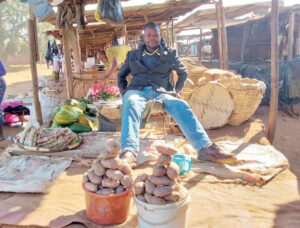
A businessman from Dambo Village, TA Kaphuka in Dedza, Chipiliro Kamwaza, is another happy beneficiary of the PSEUCT programme.
He struggled paying school fees for his children and often borrowed money from colleagues to make ends meet.
The devaluation of the currency further strained his financial situation until he was registered in the PSEUCT programme.
Kamwaza hails the government for including him in the programme, which he believes would help his business grow and make his family happy.
“I was anxious due to the rise in maize prices, but now I can buy maize in instalments,” Kamwaza, 51, says. The money has supported his family in buying basic needs, which he struggled to achieve without the programme.
“I have started using this money to buy necessities for my home. Some has been invested in my business to bolster it,” Kamwaza adds.
A farmer from Area 25 in TA Chitukula in Lilongwe, John Judge, also expresses his satisfaction with the programme, saying it came as a relief after an uncertain growing season due to the El Nino weather condition.
The previous season’s poor harvest left him hopeless about sourcing basic needs for his five children and wife, and he was struggling to buy farm inputs.
He believes the programme was a significant opportunity to improve his family’s livelihood and economic standards.
According to a press statement dated June 20, 2024, signed by Secretary for Economic Planning and Economic Affairs in the Ministry of Finance and Economic Affairs, the programme targets ultra-poor households within city wards.
The payment process is conducted in three phases to ensure smooth and efficient fund distribution. Phase one involved distributing funds to 22,339 eligible beneficiaries.
The statement said the second phase focused on transferring funds to an additional 16,328 beneficiaries undergoing the Know Your Customer verification and while phase three addresses grievances and unresolved issues.
It indicated that PSEUCT is an unconditional cash transfer programme providing a critical safety net for the most marginalised urban population, supporting their consumption needs.
Spokesperson for the Ministry of Gender, Community Development and Social Welfare, Pauline Kaude, said the programme aims to alleviate immediate economic hardships caused by the devaluation of the local currency.
“This includes strengthening the resilience of the urban poor by providing financial resources that protect them from engaging in negative coping mechanisms and boost the local economy by injecting funds to stimulate demand and supply of locally desired goods and services,” Kaude explained.
She added that the programme targets 105,000 beneficiary households in Lilongwe, Blantyre and Mzuzu cities.
It is being implemented with support from the World Bank Group and Unicef, managed by city councils with support from the Ministry of Finance and Economic Affairs, the Ministry of Gender, Community Development and Social Welfare, the National Local Government Finance Committee and Department of Disaster Management Affairs.
It is pegged at $9.7 million (K17.1 billion).— Mana