By Damian Zane:
South Africa’s governing African National Congress (ANC) has launched its manifesto for the May elections, in which some polls suggest its share of the vote could fall below 50 percent for the first time.
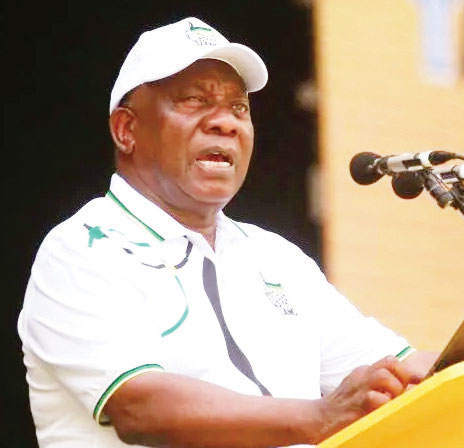
President Cyril Ramaphosa addressed thousands of supporters at a rally in KwaZulu- Natal province.
The area will be a key battleground.
Dissatisfaction with the state of the economy, public services and corruption has eaten away at ANC’s support.
- Advertisement -
The party of Nelson Mandela, who led the struggle against the racist apartheid system and oversaw the transition to democracy in 1994, has been the dominant force for the last 30 years.
But stubbornly high unemployment, which now stands at more than 32 percent, frequent power cuts and high crime levels, among other issues, have led some to turn away from the ANC.
There are challenges coming from the right, in the form of the main opposition Democratic Alliance (DA), and the more radical left with the Economic Freedom Fighters (EFF).
KwaZulu-Natal is also the home of former president Jacob Zuma, disenchanted with the party and now suspended from the ANC. He has thrown his weight behind a new formation – uMkhonto we Sizwe (MK) – which has already made some small inroads at by-elections in the province.
- Advertisement -
- Advertisement -
Speaking at a stadium in the city of Durban, with the crowd decked out in the ANC’s black, green and gold, Ramaphosa promised that “we will do better”.
It was an acknowledgement that there are problems, but he also emphasised the transformation that the country has made in the last three decades.
“South Africans are more educated, empowered and healthier than they were under apartheid,” he said, urging people not to threaten that progress.
Looking forward, his party promises to create 2.5 million “work opportunities”.
It also pledges to boost investment and support the private sector as well as “eradicate corruption”.
In his introduction to the manifesto, the president also wrote that “there are forces that seek to use this election to undo the progress of democracy. It is crucial that together we defend our hard-won freedom.”
He did not name those “forces” but the ANC knows it faces its toughest electoral environment yet.
Since 1994, it has polled consistently above 50 percent in national elections, enabling it to run the country without challenge. But with some opinion polls showing that that support has dipped below an absolute majority, South Africa is facing the possibility of a coalition government after the May 29 general election.