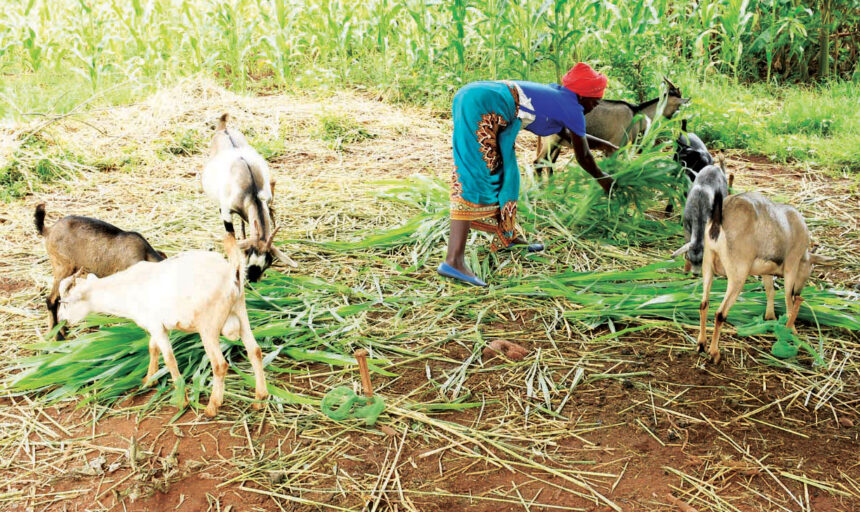

Three years ago, Rose Wailesi could not afford to send her children to school let alone consistently place meals on the family’s table.
Poverty was a common feature in her home. The harvest from the crop fields also kept falling.
“We used to solely rely on rainwater and our crops could not make it through dry spells,” the mother of three from Ikanga Village, Traditional Authority Nkapita in Zomba, says.
Her experience is similar to that of village-mate Asiatu Hassan, who also used to struggle to fend for her family.
The two women’s lives took a turn when they joined Ikanga Irrigation Scheme in their area, where they are producing crops in abundance.
- Advertisement -
“Irrigation is making it possible for us to grow crops throughout the year, ensuring there is food and money in our homes,” Wailesi says.
Together with other 34 members of the scheme, she has adopted modern agriculture techniques which help her to realise bumper harvests from small portions of land.
Now, Wailesi is able to send her children to school and manages to consistently provide food for everyone in her family.
“I have also bought a bicycle for easy mobility, using money I realised from selling beans which did really well last year. My husband also uses the bicycle to take farm produce to the local market,” she says.
- Advertisement -
- Advertisement -
Hassan also no longer worries about where food for her family will come from.
Last year, she harvested what she describes as a large amount of beans and sold part of it at K3,000 per kilogramme, a price she says is one of the highest on record.
“I have just finished constructing a new house. I also used some money to extend my farming to livestock production,” she says.
The crops are providing feed for the livestock while the animals are providing manure for her crops at the irrigation scheme.
She no longer spends a lot of money to buy fertiliser whose prices are hitting the roof.
The Food and Agriculture Organisation (FAO) of the United Nations states that loss of fertile soil is one of the major constraints to food production in Malawi.
FAO says in turn, farmers are forced to increase expenditure on fertilisers to improve production.
Local agriculture experts are popularising the return to organic ways of production, especially for small-scale farmers.
Chairperson for Ikanga Irrigation Scheme Blessings Bonzo, who is also a lead farmer, brags that the scheme has brought food security to the area apart from providing income to the farmers.
“Three or four years ago, malnutrition was widespread. Now, with a wide range of food choices, malnutrition is no longer an issue,” Bonzo says.
In the area of Group Village Head Masula in Zomba, young people who had initially resigned to fate have also recouped hope in vocational skills.
One of them, Ishmael Kasani, who does welding, says he is able to rake up to K150,000 in a week, an amount only dreamt about even by most workers in formal employment.
“My family was too poor to support my education. I am sure I would still be wallowing in poverty had I not been trained in welding,” the 28 year old says.
The vocational skills training Ishmael is talking about was possible through a USAid-funded activity dubbed Titukulane, which sought to achieve sustainable, equitable and resilient food and nutrition security for vulnerable households in Mangochi and Zomba districts.
Care and others such as Emmanuel International, International Food Policy Research Institute, National Smallholder Farmers Association of Malawi, Save the Children and WaterAid Malawi, is implementing the project.
Since 2019, they have been providing support to empower the vulnerable households through irrigation farming and vocational skills, among others.
It is also through the initiative that Wailesi, Hassan and Kassani’s lives have been transformed.

Titukulane programme manager at Save the Children Wales Magumbi sees “great transformation” in households participating in the activity.
“We have built the capacity of over 2,000 young people through vocational skills training, while in terms of irrigation farming, we have provided opportunities to over 10,000 farmers and we have reached close to 100,000 households with various forms of assistance,” Magumbi says.
Titukulane, which is also supporting the implementation of the Malawi National Resilience Strategy (NRS), follows disasters that hit the country in recent years such as the Covid epidemic and floods triggered by cyclones.
NRS guides investments in agriculture to reduce the impact and improve recovery from the shocks of the catastrophes apart from promoting household resilience.