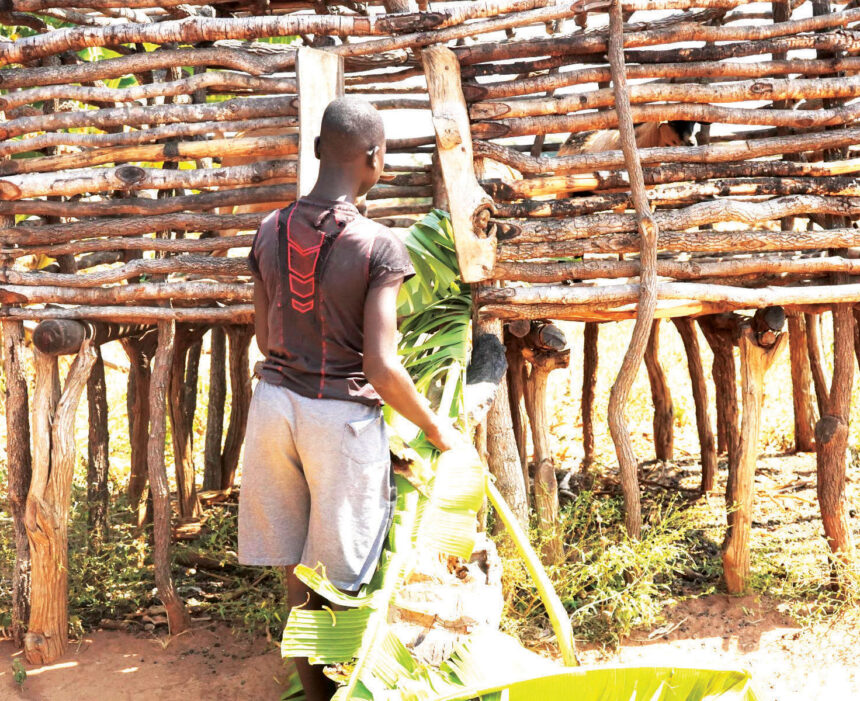
The sun rises warmly over expansive yet empty fields in Chabandauka, a rustic village in Mzimba Southwest.
The location is relatively quiet, save for sporadic movements of cattle and rustling leaves as the breeze sweeps across open spaces, stirring up dust into the atmosphere.
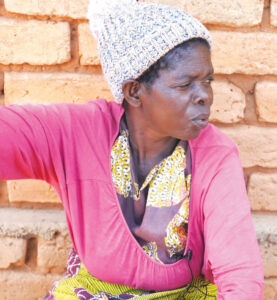
We arrive at the home of Justina Nkhata in the heart of the plain village, where children are ensnared in work beyond their years.
Nkhata, 62, is worn out from the struggles she faces in caring for five children—four belonging to her divorced daughters and one of her own.
“Caring for these children is not easy because I am poor. My grandchildren’s parents rarely provide support,” she tells us, seated on a low stool at one end of her red-brick house.
- Advertisement -
Our visit to this rural village aims to document stories of child labour, following reports that the long-standing crisis shows no signs of abating in Malawi’s largest district by land area.
Here, efforts to combat child labour seem like faint whispers against a backdrop of tradition and apparent poverty-driven necessity.
Nkhata allowed her grandson—whom we will call Lusayo—to trek to a distant village where he worked in a tobacco estate for six months without pay.
“He had nothing for school, so he chose to work in the tobacco fields. It’s not like I forced him to go there,” she claims.
- Advertisement -
- Advertisement -
Nkhata however acknowledges responsibility by permitting the decision and letting Lusayo work in hazardous conditions for half a year.
When we inquire about how much the 16-year-old earned from his toil, the grandmother reluctantly mentions K26,000—an amount Lusayo never received or was even aware of.
This suggests she may have received the money from the boy’s employer.
“Even that K26,000 is not enough. The agreement was that he would receive K50,000 at the end of the year, which was the contract period.
“Where in the world does one receive that amount after working for a year?” she asks rhetorically.
Lusayo explains that he lost everything he was supposed to receive at the end of his arduous work in the tobacco fields due to a breach of contract.
The conditions were not even written down—instead, they were orally agreed upon, with a simple nod.
“My employer said because I had been withdrawn from work, it was impossible for him to pay me,” Lusayo laments.
He tells us that he agreed to work in the tobacco fields hoping to provide food for his struggling family and to buy school materials to continue his education.
At the time he left home for the tobacco estate last year, he was in Standard 7 at a primary school in his area.
“I returned to school and wrote my Primary School Leaving Certificate of Education examinations. I am hoping for positive results,” Lusayo narrates.
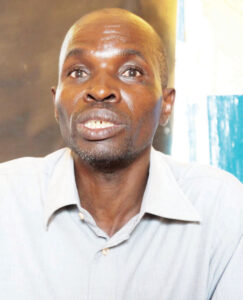
While Nkhata expresses satisfaction with the boy’s return to school, facilitated by local child protection worker Denis Gondwe, she remains unsettled.
Lusayo has been performing well in class since re-enrolling and has the potential to progress to secondary school.
“That will mean needing more money for school fees and other essentials. In fact, even if he doesn’t make it to a public secondary school, I can’t afford to pay for his education at a private school,” Nkhata says.
She hopes her children will step in to help the boy, noting his growing interest in school with each passing day.
According to the Child Care, Protection and Justice Act, parents are obligated to do everything in their power to ensure their children live good lives.
The law stipulates criminal penalties for parents who abandon their children for any reason.
“But the challenge is that my grandchildren’s parents have new families to which they are now dedicated,” Nkhata says.
When we suggest that the parents risk facing criminal charges for abandoning their children, she insists that according to custom, there is nothing wrong with parents leaving children in the care of their grandparents.
We also inform her about the Employment Act, which sets the minimum age for admission to employment at 14 years and prohibits children between 14 and 18 years from engaging in hazardous work.
She claims she was unaware of this and pledges to ensure that no child in her care undertakes work beyond their years.
“Many of us in rural areas are not aware of such legal provisions,” she says, advocating for greater awareness.
Lusayo himself states that he is unwilling to return to the tobacco estate where, during his six-month stint, he was joined by several other children his age.
“We never had a voice, even when we were being mistreated. We ate once a day. Sometimes, we worked the whole day without eating anything,” he recalls dejectedly.
Gondwe laments the persistence of child labour in Mzimba, particularly his area of jurisdiction spanning the whole of Traditional Authority Mzukuzuku.
“Many children are exploited by estate owners due to extreme poverty, while being cared for by their grandparents,” Gondwe explains.
He adds that estate owners prefer children because they are less likely to negotiate better wages and their voices can be easily silenced.
The child protection worker states that legal action is being pursued against a Mr Mumba, who employed Lusayo, although he admits such cases are challenging to argue in court.
He recounts that within his jurisdiction, covering dozens of villages, 78 children—including six girls and 73 boys—have been rescued from child labour.
“The girls were mainly engaged in small-scale businesses, while boys were predominantly involved in tobacco production and tending livestock,” Gondwe explains.
According to the National Statistical Office (NSO), 38 percent or 2.1 million children in Malawi aged between five and 17 were engaged in child labour in 2015.
The NSO reports that the majority of them were employed in high-risk jobs, including on tobacco estates.
The Malawi National Action Plan on Child Labour aims to eliminate child labour, including its worst forms, across all sectors of the economy by 2025.
Stakeholders are concerned that progress towards this target is currently inadequate.