
It used to be a long and tiresome journey for Chimwemwe Njobvu to find a suitable bull, transport it to her small farm and wait for it to mount and naturally mate with her cows.
But now, the young dairy farmer from Chipande Extension Planning Area (EPA) in Blantyre can simply deposit semen extracted from high-quality bulls into her cows’ reproductive tracts to achieve pregnancy, thanks to science.
“Apart from transport costs, manual mating brought several other challenges, including missing the cow’s heat period due to the time it took to bring the bull from, say, Chiradzulu to my kraal in Traditional Authority Makata in Lunzu, Blantyre Rural,” the 33-year-old farmer says.
Mating is supposed to take place as soon as the cow shows signs of being in heat.
But according to Njovbu, most farmers would miss this window. By the time the bull arrived, it would often be too tired for the task at hand.
- Advertisement -
She says this used to affect the quality of the offspring.
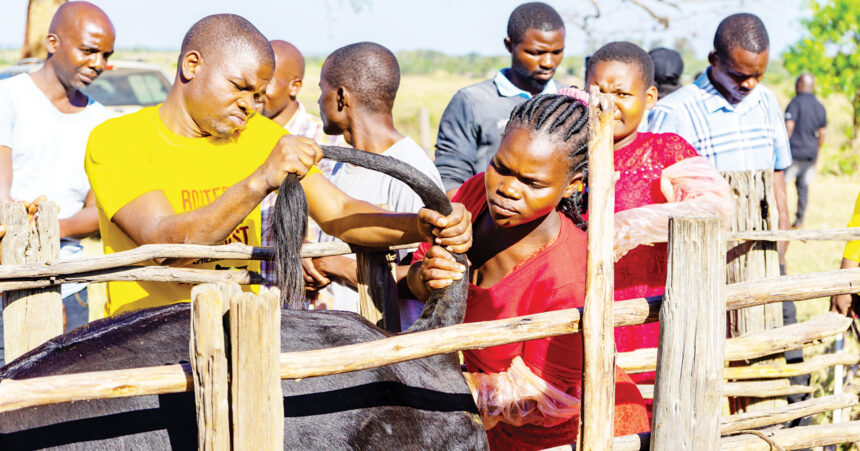
Njobvu, along with several smallholder farmers from her area, has received training in artificial insemination (AI), a process of manually depositing semen into a cow’s reproductive tract to achieve pregnancy without natural mating.
AI is a widely used technique for improving herd genetics and managing breeding more efficiently.
Through the training, Njobvu now has hands-on knowledge of how to extract and insert semen into her cows and those of other farmers in her area.
- Advertisement -
- Advertisement -
“The training has also opened up other opportunities for us, as we can now go and collect semen from the National Artificial Insemination Centre at Mikolongwe in Chiradzulu for our cows.
“This is a very good thing because we can store the semen and use it when our cows are in heat, which was not possible before, when we had to physically transport bulls to our areas,” Njobvu says.
But that is not all. She and the farmers who have undergone the training can now provide AI services to others in their communities.
“So, the training has also provided us with a form of self-employment, as we will be offering artificial insemination services in our communities,” Njobvu adds.
Herbert Chigona, a commercial dairy farmer, says the sector has made progress over the years due to modern farming technologies such as AI.
According to Chigona, AI has enabled more dairy farmers across the country to access improved breeds.
“As a result, we have seen an increase in milk production compared to five years ago, because many of the animals with our farmers are improved breeds,” Chigona says.
He adds that milk production in the country has risen to 66 million litres, which is a marked improvement from the previous year’s 61 million litres.
However, Chigona says dairy farmers continue to face challenges in feeding their animals adequately to maintain milk production.
“There is currently a scramble for madeya (maize bran) due to climate change-related issues and some people are exporting the feed, making it not only scarce but expensive when it is available.
“There is a need for more research and innovation to ensure a constant supply of feed for farmers in the country,” Chigona adds.
Despite these challenges, Chigona maintains that progress has been made in improving Malawi’s dairy herd.
“We now have around 70,000 pure breeds in the country, with the rest being cross-breeds between local and hybrid varieties,” he says.
For years, the National Artificial Insemination Centre at Mikolongwe in Chiradzulu has been assisting farmers by providing readily available semen for their cows.
The centre has also been training smallholder farmers in artificial insemination and pregnancy diagnosis techniques for use within their communities.

The semen, collected from quality bulls, is stored for use over long periods.
“This is why such technologies are important to farmers, as they allow them to inseminate at the point of need,” National Artificial Insemination Coordinator, Fatima Kazembe, says.
Kazembe says the centre’s training programmes have contributed to the increase in both dairy and beef pure breeds in Malawi.
“Since we use pure breed bulls such as Jersey and Friesian for artificial insemination, the production is definitely higher and the milk yield is also greater.
“We sell the semen to farmers, which helps them cut the cost of keeping a bull,” Kazembe says.
Among its many benefits, artificial insemination also offers an easy way to impregnate cows with disabilities that cannot stand properly.
Kazembe explains that in the AI process, the bull is exposed to an artificial vagina mounted on what is called a teaser bull.
Once collected, she adds, the semen is taken to a laboratory where tests are conducted to establish motility and concentration and to screen for stains and fungi.
Only after confirming that the semen is of high quality is it made available to farmers as fresh semen, which can be stored for about five days before use.
The rest is stored at minus one degree Celsius in frozen form and remains viable under liquid nitrogen for thousands of years, according to information provided to us.