Malawi’s aspiration to attain the middle-income mark by 2030 looks increasingly uncertain, as persistent underfunding and misaligned budget priorities continue to weigh down the implementation of the Malawi 2063 First 10-Year Implementation Plan (MIP-1).
A joint 2026-2027 National Budget Analysis Report by the National Planning Commission (NPC) and the Economics Association of Malawi (Ecama) shows that over the past five years, financing for MIP-1 has fallen significantly short of requirements, particularly in the early stages of implementation.
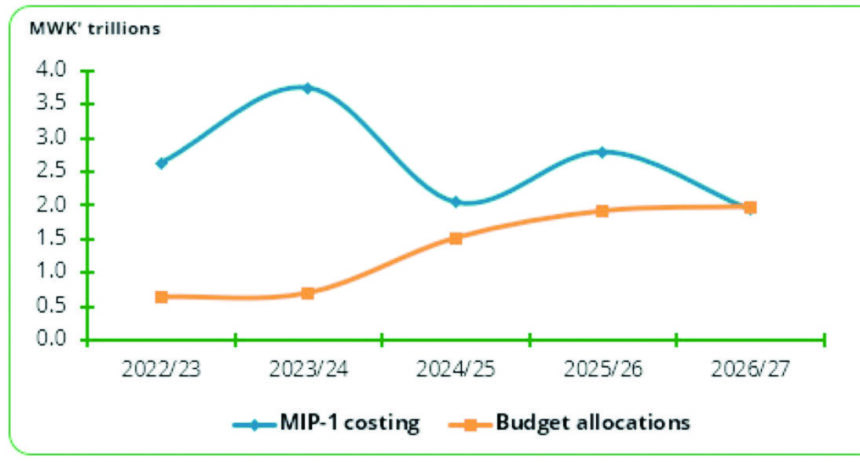
The report indicates that in 2022 alone, the total estimated cost of implementing MIP-1 stood at about K2.5 trillion, yet only K640 billion was allocated in the national budget—creating an underfunding gap of roughly 80 percent.
Cumulatively, only 44 percent of the required financing has been met, leaving a staggering K7 trillion shortfall.
The report notes that this financing deficit, coupled with persistent misalignment of budget allocations to priority areas, has undermined and contributed to the underachievement of MIP-1 targets.
- Advertisement -
Although the gap between required resources and actual allocations has narrowed from 2024 onwards, with the 2026-27 budget projected to nearly match annual MIP-1 cost estimates, analysts caution that this does not imply adequate funding.
Many projects, initially planned for early implementation, were delayed and pushed forward, creating a backlog that continues to constrain progress.
“Despite this apparent convergence, it should not be interpreted as an indication that MIP-1 has been fully or adequately funded. Many interventions that were originally scheduled for implementation in the early years of MIP-1 were not executed as planned and have since been deferred to later years,” the report reads.
It further notes that since the rollout of MIP-1, the development budget has steadily increased in absolute terms. However, allocations have not consistently aligned with the plan’s strategic focus on agricultural productivity, industrialisation and economic infrastructure.
- Advertisement -
- Advertisement -
Instead, a significant portion of resources has been directed towards human capital development, environmental sustainability and public sector enhancement—an imbalance that persists in the 2026/27 budget.
For instance, it notes that in the agriculture sector, government spending has largely been dominated by farm input subsidies, which, while crucial in sustaining production, have crowded out investments in productivity-enhancing areas such as mechanisation and structured markets.
However, the report acknowledges that the 2026/27 budget signals a shift, with increased allocations towards mechanisation and market systems aimed at promoting commercialisation and value chain development.
If effectively implemented, these reforms could help address long-standing bottlenecks in productivity and market coordination, aligning the sector more closely with MIP-1’s wealth creation agenda.
The industrialisation pillar which is widely regarded as central to Malawi’s economic transformation, remains critically underfunded despite recent nominal increases in budget allocations.
Funding for the sector rose from K9.66 billion in 2025/26 to K23.97 billion in 2026-27, which the institutions described as a positive development on paper.