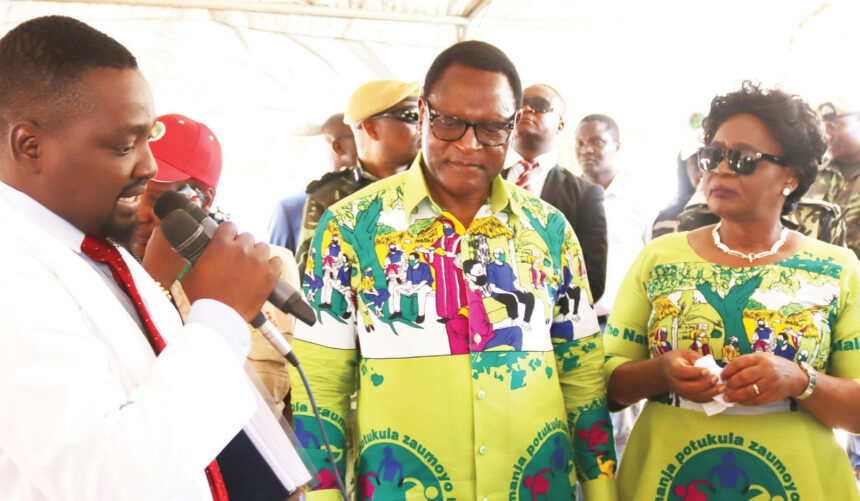
President Lazarus Chakwera has said the government has started closing the human resource gap, citing its plan to hire over 10,000 additional health surveillance assistants (HSAs) and increase the number of assistant environmental health officers, community health nurses and community midwife assistants.
He said the recruitment drive is a component of the National Acceleration Community Health Roadmap, which points out key priorities for community health in Malawi to address community health challenges.
Chakwera said this in Likoma District during commemorations marking National Community Health Day.
At the event, government officials also relaunched the Human Papilloma Virus vaccine as well as the Tipewe Cholera and Covid campaign in the district.

There are over 11,000 HSAs in Malawi.
- Advertisement -
For the last five years— that is, from 2017— the government was implementing the National Community Health Strategy whose 2022 target was to, among other things, construct 900 health posts in hard-to-reach areas.
However, according to Chakwera, the government has only managed to construct 30 health posts out of the targeted 900, with 45 others currently under construction.
Chakwera, who sounded optimistic, said the government would still construct the health posts, as outlined in the successor National Community Health Framework (2023-2030), adding that 1,800 community health worker housing units would be constructed in hard-to-reach areas.
“And since I became President in 2020, we have recruited 1,578 [healthcare workers] using resources from both government and partners, which is already over 10 percent of the total target, and we will continue steadily on this path until the roadmap is fully realised,” he said.
- Advertisement -
- Advertisement -
In her remarks, Health Minister Khumbize Kandodo Chiponda hailed partners for their continued support to the health sector, disclosing that the World Bank has supported Malawi with $9 million for the purchase of drugs.
The support comes at a time the Ministry of Health has appealed for a K15 billion drug budget.
This transpired when its officials appeared before a Joint Parliamentary Committee on Health and Government Assurance and Public Sector Reforms.
In her remarks, United Nations Resident Coordinator Rebecca Adda-Dontoh committed to continue supporting Malawi in interventions aimed at improving healthcare service delivery.
Adda-Dontoh said realising that the rainy season is fast approaching, the campaign that has been launched should help intensify core preventive measures against cholera.
Meanwhile, Senior Chief Mkumpha of Likoma District has asked Chakwera to consider introducing two or more vessels on Lake Malawi, arguing that Ilala is old and tired.
Mkumpha said because Ilala is the only reliable vessel, it is mostly overloaded.
He decried short supply of maize in Admarc depots in the district, pleading with the government to restock them.
Adding on this, Member of Parliament for the area Ashems Songwe said 400 bags of maize that the district receives per week are not enough.
Before the commemorations, Chakwera toured an Electricity Generation Company (Egenco) solar plant in Likoma District.
It generates 1,000 kilowatts.
Initially, the district was depending on diesel generators which were installed in Likoma in 2002 through the Malawi Rural Electrification Programme and were costing Egenco about 28,000 litres of fuel every month.
Egenco spokesperson Moses Gwaza said the solar plant has improved the livelihoods of people in the district, saying the current generation capacity is higher than demand.
“People are only consuming one-third of what we are generating and we are hopeful that this will remain the same in the next 10 years,” he said
Chakwera also inspected the Likoma Jetty construction site, which is at 75 percent and is expected to be completed by March 2024.
Commemorations marking National Community Health Day started in 2017 and are aimed at raising awareness about the importance of community health, apart from recognising the role of community health workers and other stakeholders in strengthening health delivery systems across the country.