
itself
By Charles Mpaka:
In almost every investment of note in biodiversity conservation in Malawi, the image of the government looms large.
Its coat of arms or the official identity symbols of the leading government department stand conspicuous on communication materials — sometimes located more prominently than those of implementing partners.
It is diplomatic tradition.
However, as evidence shows, Malawi barely funds many of its own conservation projects and experts warn that heavy reliance on private financing will not deliver conservation objectives.
- Advertisement -
In March this year, Malawi set up a state-of-the-art National Forestry Monitoring Centre at the Ministry of Natural Resources headquarters in Lilongwe.
Rigged with modern technology equipment, this first-of-its-kind centre in Malawi will monitor forest degradation and restoration trends across the country.
This will enable the country to have real-time and more reliable data for more appropriate interventions.
The centre has been set up with funding by foreign institutions.
- Advertisement -
- Advertisement -
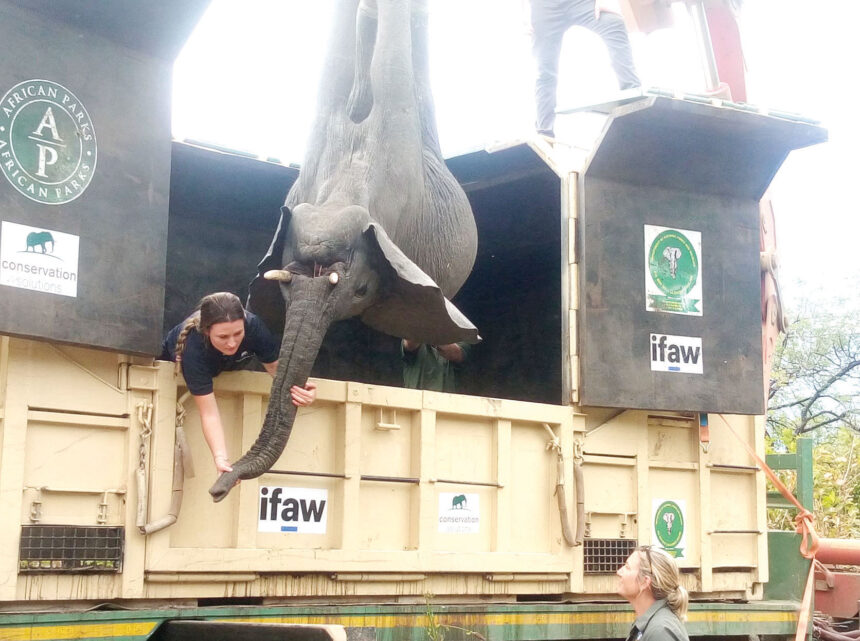
In July last year, Malawi made headlines in global conservation circles when it translocated 263 elephants from Liwonde National Park to restock Kasungu National Park.
The exercise was estimated to have cost more than $1million. It was supported by African Parks and International Fund for Animal Welfare (Ifaw).
That translocation to Kasungu National Park happened because the once-degraded park has now been rehabilitated.
For more than two decades, the 2,000-square-kilometre park lay in ruins — ravaged by poaching and poor management by the government.
In 2017, Ifaw launched the Combating Wildlife Crime project, funded by USAID, which led to improvement in law enforcement and rehabilitation of the park, making it viable for habitation of increased number of wildlife species.
Without such external financing, Malawi would have hardly managed to make these significant investments through public funding alone.
Inadequate funding patterns
Malawi’s public funding for conservation is perpetually short. For instance, in the past three national budgets, the Department of National Parks and Wildlife has been allocated less than K500 million (around $470,000 in current exchange rate) annually.
In the 2023-24 budget, the department has an approved allocation of K352 million (about $331,000).
In the 2022-23 financial year, it had an approved budget of K453 million ($426,000) and then K255 million ($240,000) in the 2021- 22 national budget.
In our earlier analysis of forestry funding trends, we found that over the past 24 years since 1998, not in a single year has the Department of Forestry received the critical Other Recurrent Transaction (ORT) funding that is even half of its budgeted requirement.
For instance, in five consecutive financial years between 2003 and 2008, the department received an average of K54.7 million per annum in ORT. That was way below its average requirement of K250 million for its eight cost centres.
In the 2013-14 budget, out of the K131 million approved budget for ORT for all its eight cost centres, the South cost centre received K16. 5 million to manage daily operations at 40 forest reserves and 15 plantations covering a total of nearly 22,000 hectares.
In the period 2016 – 2021, Treasury consistently cut ORT approved budgets for the department. In the 2020- 21 budget, for example, it reduced the budget from K302 million to K208 million against the department’s minimum ORT requirement of K700 million.
These patterns of public underfunding, and therefore heavy reliance on private financing, stretch across the length and breadth of biodiversity conservation in Malawi.
Brighton Kumchedwa, Director of National Parks and Wildlife admits the inadequate public funding challenge to the department. But he indicates that some gaps are plugged by grants from partners who direct their funding to the department.
In effect, government is heavily reliant on private financing for its own conservation agenda.
Kunming-Montreal framework
At the Convention on Biological Diversity’s COP15 in December 2022, parties struck the Kunming-Montreal Global Biodiversity Framework (GBF) agreement which charges rich countries to scale-up investment in biodiversity conservation in low-income countries.
This position followed the concern that inadequate funding was making it difficult for poor countries to meet global biodiversity targets.
However, countries like Malawi seem to have left almost all the financing requirements to external sources. And, a study published in Nature Ecology & Evolution journal on June 12, 2023 warns that heavy reliance on private finance alone will not deliver conservation goals.
“…Successful nature-related investments will require more, rather than less, of a role for the public sector,” argue the researchers Katie Kedward and Josh Ryan- Collins from the University College London, Sophus zu Ermgassen from University of Oxford and Sven Wunder from the European Forest Institute in Barcelona, Spain.
They observe that well-targeted private, market-based financing mechanisms do address some drivers of biodiversity loss. However, they say, sound private investments in ecosystems require both competitive financial returns and effective, truly additional conservation results.
Striking the balance
The idea in private financing is that it will be mainstreamed into public spending; but this comes up again some challenges.
“First, creating a mechanism for capturing an alleged private willingness to pay for public environmental goods is difficult, given strong incentives for free-riding (reaping benefits while imposing costs on others).
“And second, it is not easy to achieve sufficient market scale, liquidity and efficiency for these instruments to appeal to institutional investors,” they say.
The experts therefore recommend a stronger role for public oversight, such as financial regulation of emerging nature-related assets, and redirection of underutilised sources of public finance to increase public investment in conservation.
Their point, they say, is not that there should be no role for private biodiversity-related finance.
Neither are they coming up with a false contract between public and private funding in countering nature loss.
“Rather, we argue that the aims of the post-2020 GBF might be more quickly and effectively realised through pursuing the right balance of public and private financing solutions, alongside civil society participation and oversight,” they say.
Self-financing opportunities
Herbert Mwalukomo, Executive Director for Centre for Environmental Policy and Advocacy (Cepa), suggests that government’s everyday excuse that it does not have adequate funding does not really hold.
He says the environment sector is capable of financing itself if the resources it generates are put to good use.
Besides, most of the environment sectors have dedicated, legally established funding pools but government hardly channels the resources to these funds.
“Where it does, the resources are hardly used to finance conservation activities such as law enforcement,” he says.
For example, tourism establishments pay a tourism levy. Tourism benefits significantly from natural resources such as wildlife, forestry, fisheries, water and artefacts.
If Malawi was serious about biodiversity conservation, this levy should have been ploughed back into managing the environment.
Malawi has also been generating money from motorists in the form of carbon levy.
“Until now, this money has not been made available for addressing challenges caused by carbon emissions.
“We can register significant strides if the Ministry of Finance ensures that the money generated from this levy is made available for conservation and climate change adaptation initiatives,” Mwalukomo tells Malawi News.
Abdicating responsibility?
Asked whether one can now say that in heavily relying on external financing, government is abdicating its responsibility of conserving Malawi’s biodiversity, Kumchedwa says “not necessarily”.
“Government is there with labour force, and as a policy holder and a regulator,” he says.
But this alone is not enough, he indicates.
“Our call is for the central government to increase its budget allocation.
“Government is now prioritising tourism, for example, as one of the three sectors that can drive the economy. Wildlife is the backbone of tourism in Malawi, hence needs adequate public investment,” he says.