At first light, a ghostly mist clings to the slopes of southern Malawi’s Mount Mulanje. It veils jagged, reddish-brown gashes carved by Cyclone Freddy, violent reminders of the landslides that tore through the slopes. These scars bear witness to one of the worst natural disasters in the country’s recent memory.
Below, in the haunting stillness of Nkhulambe village, the morning breeze moves gently across a barren expanse where maize once flourished and laughter echoed. Now, silence remains, punctuated by the rustle of tarpaulin and the crunch of footsteps breaking earth.
Naomi Yohane crouches beside the cracked foundation of what was once her family home. She is 37, though the wear in her eyes suggests more. Beside her, no laughter, no child’s footsteps – only absence.
“I still have dreams where I hear Blessings calling out for me,” she says of her seven-year-old daughter, her voice calm but heavy. When the cyclone struck, both were swept ten kilometres away by a monstrous deluge – water, mud, and rock cascading from the mountain like liquid fire.
Bloodied and bruised, Yohane survived by clinging to a mango tree for three days. Her daughter’s body was never found.
- Advertisement -
It’s been more than two years since Cyclone Freddy, one of the most energetic ever recorded, roared across southern Malawi in March 2023.
When it made landfall, it was relentless. Rain pummelled already saturated soil, triggering landslides that particularly impacted densely populated, poorer communities. In Malawi, the number of dead and missing is estimated to be over 1,200. The country’s Department of Disaster Management Affairs (Dodma) has put the economic damage at over $500 million.
The villages of Phalombe and Nkhulambe at the foot of Mount Mulanje, were particularly hard hit, as were Chilobwe and Manje, below Mount Soche, on the outskirts of Blantyre, Malawi’s second-largest city.
In Nkhulambe, many are still marked by the loss. Group village headman Nkhulambe, a soft-spoken 37-year-old who helped rescue people during the disaster, says 187 of his fellow villagers perished.
- Advertisement -
- Advertisement -
The cyclone has also harmed the land that many depend on for food. “We used to feed ourselves from the land,” he says. “But now the fields are stone. Even with fertiliser, nothing grows. And then the fall armyworms came.”
These pests, once rare in the region, now thrive in the altered ecosystem. “It’s like nature turned against us,” Nkhulambe adds.
The Malawi government, through Dodma, has worked with partner organisations to respond to Cyclone Freddy’s devastation. Spokesperson Chipiliro Khamula says the overall recovery strategy has been guided by a Post Disaster Needs Assessment, designed to mobilise resources and take action.
But progress has been slow. “Save for the construction of the new Makhanga Primary School, relocation of affected communities, and rehabilitation of roads and health facilities, overall progress has been gradual due to inadequate funds,” Khamula tells Dialogue Earth.
“The total reconstruction and recovery needs for physical and economic losses caused by Freddy amount to $680.4 million – raising this substantial amount of funds has been a tall order.”
According to Khamula, over 15,000 households – most of them from flood-prone zones like Makhanga, a village north of Mount Mulanje and close to Lake Chilwa – have been relocated to safer, higher ground. This process involved clearing access roads, transporting families, and ensuring they had access to potable water. In some cases, humanitarian organisations provided direct financial support to families for rebuilding their homes.
Based on the official average of one household comprising 4.3 people, the Dodma figures of 15,000 households would indicate that only about 64,500 of the 659,000 displaced have been relocated. Many have had to go back to their cyclone-damaged dwellings.
In the camps that once teemed with displaced families, silence now echoes. This is not because everyone left for a better place, but because some, like Mary Likopa, returned to dangerously disaster-prone zones out of desperation.
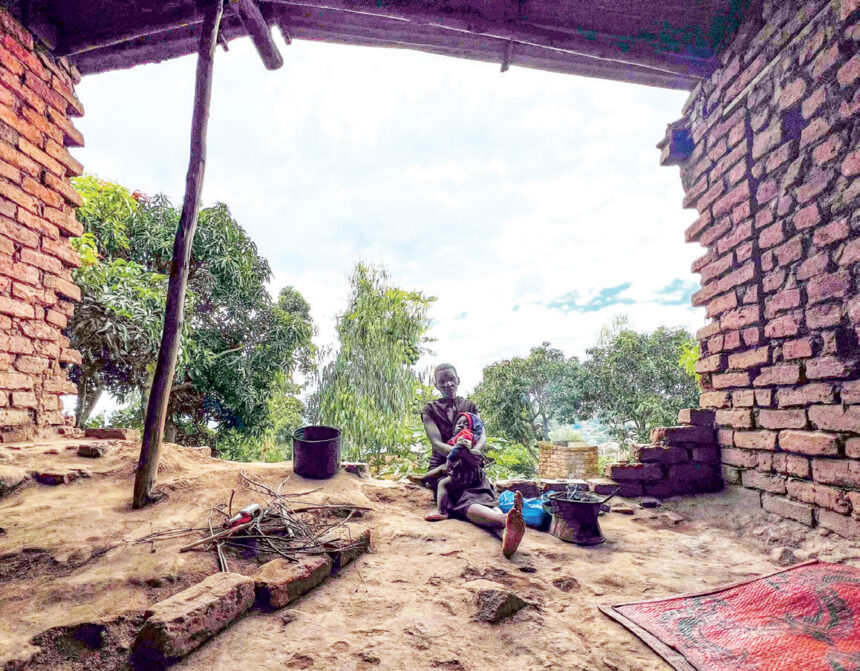
The 42-year-old widow perches on the crumbled remains of her living room wall – what used to be the heart of her home. Her mud-brick house clings to the upper slope of a hill, mostly spared by the mudslides that thundered past just a metre away. Two of her living room walls were damaged, but her neighbour’s home, just steps below, was swept away.
Here, Likopa has a haunting view of the devastation below – broken rooftops, debris, and the trail of mud that tore through everything in its path.
She cradles her two-year-old grandson, Wisdom, whose tiny frame burns with untreated malaria.
“The medicine costs three US dollars. We don’t have it,” she says. She survives on piecemeal work – washing clothes, cleaning houses, earning about $1.50 for a day’s work – but it’s not enough. After two months in the Kapeni displacement camp in Blantyre, she was sent away with a single 50kg bag of maize flour.
“No one from the government has come back since.”
Pastor David Chigamba, who represents survivors in Chilobwe, says the neglect is criminal.
“They promised to relocate us. But nothing has happened. The land here should be declared a red zone. We are sitting in the path of death.”
Every rainy season since, they flee their homes at the hint of a storm. When Cyclone Jude was forecast in 2025, they left for two weeks.
“We live in fear,” he says. “The government can fix this. They can reallocate land. They just choose not to.”
After the cyclone, the government and international donors pledged recovery funds. But on the ground, those promises seem to have drifted off.
A senior Dodma official admits that only 40 percent of the pledged funds have been disbursed.
“Bureaucracy, capacity issues, and donor conditions are slowing us down,” said the official, who spoke on condition of anonymity. “But the frustration is real, and we understand that.”
Among the humanitarian organisations responding was the United Nations World Food Programme (WFP), which launched large-scale relief and recovery operations.
WFP country director for Malawi, Hyoung-Joon Lim, says that after the cyclone WFP collaborated with Malawi’s government to provide food assistance to over 550,000 people through “in-kind food and cash transfers.”
“We prioritised displaced families in camps and flood-affected communities. We focused on areas with the highest number of displaced people and the most severe infrastructure damage.”
Aid groups admit that key recovery efforts have stalled in the face of continued funding shortages.
“WFP Malawi has experienced funding shortfalls that have affected the scale and timing of our operations,” Lim says. “It may limit the number of people in need that we can reach.”
With fewer resources, since July 2023 WFP has cut food rations for refugees in Dzaleka Camp by 50% and pulled back on community and school feeding programmes. “We’ve had to make some very tough choices,” Lim adds.
The recent USaid funding pause is likely to have made matters worse, the US having been a major donor to programmes like WFP, though Dodma says it’s hard to measure the exact impact of this.— Dialogue Earth