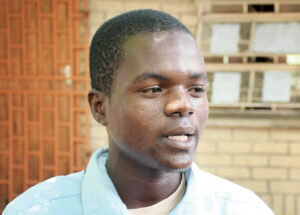
For Adam Swalley, a Form 3 student at Liwonde Community Day Secondary School (CDSS) in Machinga District, dropping out of school was one of the most painful experiences he had to endure.
Swalley aspires to become a doctor but without completing his secondary education, this remained a dream.
His parents, who are poor, cannot afford to pay his fees and were only able to pay sporadically, meaning he was constantly sent back home whenever his fees were due.
This meant he was frequently absent from classes, missing out on acquiring an education while his peers were in class.
Eventually, he had to drop out of school because his parents could not afford to pay fees for him to continue with his education every team.
- Advertisement -
“This really affected my performance as I missed the entire period of last term. I even stopped reading because I had lost all hope,” Swalley said.
His future looked bleak and there was no hope for him and the many children whose guardians do not have sustainable incomes and live below the poverty line.
However, the introduction of the free secondary school initiative by the current administration has brought hope to Adam and many learners who come from disadvantaged households.
“I am thankful as I am now attending classes without fear of being sent back home,” Swalley said.
- Advertisement -
- Advertisement -
A future that once looked dreary to Swalley is slowly turning into reality as he can attend classes freely.
Head teacher for Liwonde CDSS, Simeon Nyirenda, commended the initiative, saying, so far, nine learners who dropped out of school due to school fees and other issues have now returned to the school.
“Some of the students had registered last term but when we asked them to bring money for the School Development Fund, they never returned. Now they have re-registered and we have welcomed them,” Nyirenda explained.
At Nchalo CDSS in Chikwawa District, Moffat Chekanyanja, a Form 3 student, was also as ‘victim’ as he was constantly being sent back home because his guardians could not afford to pay his school fees.
“Since Form 1, I would come to school for about two weeks but, as soon as school officials started demanding fees, I would go home and not come back. Only when my parents raised enough money could I go back to school,” Moffat said.
For him, even passing his Junior Certificate of Education examinations was nothing short of a miracle as he only attended classes here and there for the first two terms.
In fact, he did not attend classes the whole of the final term.
“I came back to school as we were about to sit examinations last year. A classmate encouraged me to still sit examination as I had kept on reading and studying at home,” Moffat explained.
He passed but not with flying colours as he would have loved to do. But, for him, the problem was not over, as the same fate awaited him in Form 3.
“Just after four weeks, I was sent back home again until the end of the term, such that I did not sit first-term examinations,” Moffat laments.
When he was called back to school before the beginning of the second term in January, when the free secondary education initiative was introduced, he was ecstatic as now he could finally stop wearing the shame and embarrassment of being sent out of class time and again.
At Chisugulu CDSS in Phalombe District, Ethel Patrick, a Form 4 student, said some students at the school have been absent from class because of the issue of school fees.
“I also come from a poor family and my mother struggles to pay my fees. My mother has encouraged me to continue working hard and take advantage of this initiative,” Ethel explained.
Ethel encouraged peers to attend classes and work hard as they now do not have any excuse to fail in their education.

Jennifer Misinde, chairperson for Chisugulu CDSS, said people were skeptical of the initiative at first, thinking it was just a way to woo voters during the September 16, 2026 election campaign period.
Misinde said seeing it becoming a reality has brought relief to many parents who live in poverty.
“In January, the school’s management called us, community members, and explained that the first tranche of funds of over K3 million had already been sent to our school,” Misinde said.
She said now enrollment has increased at the school and that the school is also able to plan better as it is receiving money at one go.
Shire Highlands Education Division Manager Evelyn Njima said the division has 130 schools.
She said the schools had already received the first chunk in their bank accounts and, “this time around, we have also received the second chunk”.
“In February, we have also been told that we will receive another chunk,” Njima said.
During the recent opening of Ndakwela CDSS in Chikwawa, Traditional Authority Ndakwela said the initiative is a relief, especially for girls.
He said the issue of girls dropping out of school to get married due to poverty and teenage pregnancies has been a big problem.
“I am in the forefront of ending child marriages and taking to task parents who initiative this. We now have free secondary education. There is no excuse for girls to get married instead of going to school,” Ndakwela said.
Lead Her, an organisation that is championing girls’ education, especially in science-related subjects, says they feel that free secondary education will enable many learners to stay in school
Hawa Munganya, executive director of the organisation, says they have been receiving many calls from teachers and parents to pay fees for needy students as they implement their activties.
“We failed to do that because of capacity issues. We are, therefore, happy that free secondary education will enable stakeholders to close that gap,” Munganya said.
Deputy Minister for Education, Science and Technology, Francis Folley, recently visited CDSSs to appreciate how the programme had started.
Folley visited Liwonde CDSS in Machinga, Chichiri CDSS in Zomba, Chisugulu CDSS in Phalombe, Nankhundi CDSS in Chiradzulu and Ndakwela and Nchalo CDSS in Chikwawa.
Folley said the government would strive to ensure that the free secondary school education initiative is implemented with excellence so that the quality of education is not compromised.
“This initiative will not only transform individual lives but also develop the country’s human capital, thereby laying a solid foundation for sustainable national development,” Folley said.
He therefore called on students to make sure that they go to school so that the programme achieves its intended purpose.