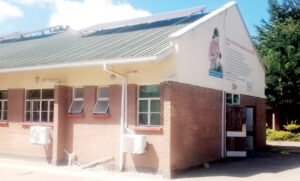
District Hospital Maternity Wing
Wednesday, June 11, 2025. At exactly 2:30pm, four tractors are ploughing the land at Nkopola Mega Farm in Mangochi District.
Surprisingly, although it is a sunny day, with the temperature at 26 degrees Celsius, the soil seems to be refusing to be thrown into the air higher than a metre.
The soil is probably burdened with the fresh memories of this year’s maize harvest, which workers at the place say was in April this year.
This means drivers of the tractors and whoever has given them the task of ploughing the soil are thinking about the next harvest of maize, meaning that they are on course to cultivating and harvesting at least twice a year.
This means, unlike the rest of Mangochi, and as far as mega farming is concerned, Nkopola Mega Farm is a land of plenty, steeped in its own order of agricultural transformation.
- Advertisement -
No wonder, in his State of the Nation Address (Sona) presented to Parliament on February 14 this year, President Lazarus Chakwera mentioned the farm as one of the places where progress was not just being made but also brewed.
The President said there was progress made in relation to the “rehabilitation of the 300-hectare Nkopola Mega Farm” in the lakeshore district.
When we visited the place that Wednesday afternoon, we found people not only working but also engrossed in the State President’s vision of turning the country into a food basket as opposed to the basket case it was apparently becoming.
The hope of Chakwera is that, in addition to Affordable Inputs Programme subsidies given to 548,118 beneficiaries over the past four years, National Economic Empowerment Fund (Neef) fertiliser loans worth K637 million Kwacha, food support that was provided to 123,433 households, an investment of K6.5 billion, Mangochi would be on course to becoming one of the food producers of the nation.
- Advertisement -
- Advertisement -
The President indicated, in the Sona, that there were other outreach activities that had taken place in the district.
“In the time that I have been President, what we have delivered to the people of Mangochi includes social cash transfers to 28,367 households, climate smart cash transfers to 25,502 beneficiaries, post-Cyclone cash transfers to 3,592 families, El Nino Lean Season cash support to 26,112 beneficiaries,” Chakwera said.
At Malindi, Abdul Mwamadi acknowledged that he was one of the people that received cash transfers, describing them as “a stitch in time”.
In the area of Senior Chief Chimwala, Mainesi Saidi said she was grateful to Neef for providing her with a fertiliser loan.
“I have invested it in maize farming and I hope to repay the loan once I sell produce,” said the mother of three.
At Mpiripiri, which happens to be at the trading centre in Makanjira, Puna Muhammad said she would, probably, have died of hunger had the government not enlisted her among people that received El-Nino Lean Season cash support.
The President also mentioned the issue of loans, notably cash loans for starting businesses amounting to K6.7 billion that were given to 9,748 beneficiaries, plus support with access to financing for another 1,559 small and medium enterprises.
“Under Marep [Malawi Rural Electrification Programme], 350 households now have electricity, 3,373 households now have electricity under Meap [Malawi Electricity Access Project (Meap)] and 10,697 have solar power,” he pointed out.
The good thing about Meap is that the World Bank has extended it by six more months. Initially, Meap, which was rolled out in 2022, targeted to connect 180,000 households and was supposed to come to an end in June this year.
Electricity Supply Corporation of Malawi (Escom) Chief Public Relations and Communications Officer Pilirani Phiri confirmed that the initiative has been extended, saying Meap will now run up to December this year.
“We are excited with the extension and the positive impact that the project has registered across the country. This is empowerment at its best. As we all know, electricity is a key stimulus for economic growth and national development,” Phiri indicated.
As at the close of business on Friday, Meap had connected 146,000 Malawians to the electricity grid, with Phiri pointing out that households within a 500-metre radius of an existing transformer can apply for Meap connections through flexible instalment options.
The Escom publicist said the cost of a new Meap connection is K93,200, adding that customers who cannot afford the full connection fee can pay a deposit of K17,475 and settle the balance in instalments after being connected to the grid.
“Meap also has a provision for Ready Boards; an affordable alternative for households [that are] unable to afford full house wiring. These are available for K64,074, with instalment options starting at K5,825,” he said.
The World Bank has, through the Government of Malawi, injected $71 million in Meap as part of the country’s nationwide drive to expand access to electricity.
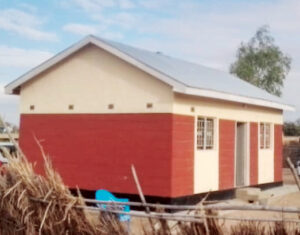
In terms of Marep, its positive impact is felt at Mtimabi Trading Centre, where there is a fledgeling market as well as Mtimabi Health Centre, maize mills, barbershops, phone charging stations and other structures.
Patricia Chitani from Nanganga Village, Traditional Authority (TA) Chimwala, says connection to Marep electricity has resulted in reduced prices for maize milling services.
“Before the connection, we used to use diesel maize mills and we were being charged K1,700 for a pail of maize. We are now paying K1,300 for a pail when we use maize mills. Owners of diesel-powered maize mills used to reap us off,” she said, a pail of ground maize on her head.
For Junior Sanudi, who is from Machenji Village, TA Chimwala, the Marep project has enhanced security in the area.
“We now use security bulbs. We charge phones in our own houses.
“Mtimabi Health Centre has also started offering services it was not offering in 2022, when we did not have Marep power. Now people are being operated right here, or delivering babies here, instead of travelling to Mangochi Boma, a distance of 60 kilometres or so,” said the father of two.
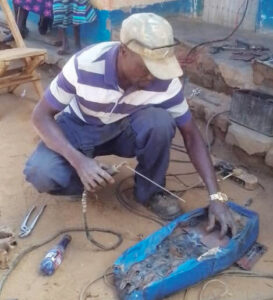
One of the residents of Mtimabi Trading Centre, Ali Mselemi, also known as ‘General’ in the area, said his welding business is flourishing, thanks to electricity connection.
“Things are going on well for me. My welding business is booming. I also do car repairs when the need arises. I do that while listening to music from my electricity-powered gadget,” he said.
Katema Village Development Committee Chairperson Sait Abdullah Foster said all they want are development projects that transform their lives.
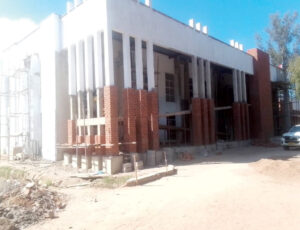
Another activity Chakwera mentioned pertains to the construction of the Mangochi District Chamber and finance offices, “now at 72 percent”.
When we visited the structure, we found that the completion rate was around 80 percent, meaning that progress had been made between February 14 and Tuesday, June 10, 2025.
This is under Contract Number M H D C / N C B /M BSP11/5/2023/01. The project started on January 8, 2024.
The initiative is a joint venture between the Government of Malawi and the Embassy of Iceland.

Mangochi District Commissioner Davie Chigwenembe said the chamber and finance offices would add beauty to the district, as the structures were modern.
“We currently have no offices for those who work in the finance department. They were in congested rooms. Once the structure is ready for use, they will be working under one spacious roof, which will improve service delivery. Finance officers from all sectors will now be working under one roof.
“As for the council chamber, it will strengthen decentralisation as it will have modern offices for the district chairperson as well as vice chairperson. Apart from these structures, we also have a modern cold room, which has facilitated the proper storage of vaccines and other medicines. This will improve health outcomes in our district,” Chigwenembe said.
According to cold room technician Benson Chitowe, the new cold room has enough space, with sound temperature control mechanisms.
“We use fridge tags and ensure that the temperature is oscillating between +2 degrees Celsius and +8 degrees Celsius. The cold room’s coming has been timely and life saving as we no longer have cases of drugs expiring due to poor temperature control,” Chitowe said.
The cold room in question is at the maternity wing of Mangochi District Hospital.
In fact, the cold room did not come from nowhere; it was cited by Chakwera in the Sona.
“We have rehabilitated Mangochi District Hospital EPI [Extended Programme on Immunisation] and cold rooms,” he told parliamentarians.
In terms of security enforcement, Chakwera said progress was being registered in that regard, too.
“We set up a new border post at Katuli to enhance security and revenue collection. We completed 90 security staff houses,” he said.
When we visited Katuli, we found that offices for police officers at the border had taken shape, with tasks such as roofing, electricity and water connection remaining.
“Once completed, we, traders, expect administrative work to be going on smoothly. We, Malawians, have maize fields in Mozambique. As such, the border is very important as it acts as a transit point for our goods,” said Frank Gama, who we found bringing four 50-kilogramme bags of maize into the country using a bicycle.
Not to be left behind, the Malawi Revenue Authority has started constructing a red brick office closer to Malawi Police Service offices that are being constructed.
In terms of the construction of houses for security agents, Namwera Police Post is one of the beneficiaries. There, some three kilometres from the police post, three spacious houses for security officers have been constructed and roofed.
What is remaining is water, electricity connection and final works inside the house.
The other item Chakwera mentioned was free water connection.
“We have also delivered free water connections to 9,752 households over the past four years,” he said.
Indeed, at some of the hospitals we visited, including Namiyasi, we found women drawing free water from taps.
“We no longer cover long distances to fetch water. Waterborne diseases are also a thing of the past,” explained Patuma Idi, a 32-year-old mother of three we found at the hospital, which is located along the lake on the Nkopola side.
Ngatali is one of the 25 health centres that have been constructed over the years; others being Nalikolo—which the Sona referred to as Nalikoko— Ngatali, Luchichi, Mpinganjira, Ntalika, Jekete, Makoli, Misolo, Mpumbe, Namiyasi, Thumu, Mayera, Binali, Lupetere, Mnani, Kwitunji, Chinganda, Dickson, Bwanali, Chiponda, Thundu, Zambo (Mbvunguti), Wandikanga, Mkwanda, Saidi Tiputipu and Kanyenga.
Probably the greatest miracle is happening in Makanjira, some 101 kilometres from Mangochi Boma.
Mangochi District Council Chairperson Abdullah Yusuf, who is also Makanjira North Ward Councillor, said one of the challenges people have been facing there relates to healthcare service delivery.
“It takes hours for ambulances to travel from Makanjira to Mangochi District Hospital. Now, with construction of a comprehensive healthcare facility, namely Makanjira Centre for Emergency Obstetric and Neonatal Care, things will change for the better. Service delivery will go beyond the provision of women-in-labour and under-five children services.
“I must say that development activities are taking place in various parts of the district,” he indicated.
Senior Group Makanjira agrees.
He said community members have longed for a comprehensive service delivery hospital for a long time, a dream that is about to materialise.
According to facility-in-charge and clinical technician Agneti Chikwete, the finalisation of construction works will help improve health outcomes in the area.
“This is because most services will be provided to patients right here, instead of Mangochi District Hospital. This means we will save lives.
“We will even find it easy to do immunisation and other work, which will lead to the creation of a healthy community; community members with health-seeking behaviour,” Chikwete explained.
Crescent Komwa, who is the site foreman for Dec Construction, said the completion rate of the works was 92 percent.
“This is a state-of-the-art facility. Among other things, it will have a nurses’ station, antenatal ward, labour ward, bathing rooms and toilets, two theatres [main and minor], sterilisation centre, autoclave, doctors’ office, waiting room, among others,” Komwa said.
Chigwenembe is equally hopeful.
“The hospital used to operate at a low level. It focused on the provision of under-five children services and maternity services. Once completed, the facility will lead to the scaling up of that. It will even be providing cancer screening services, among others,” he said of the K2.3 billion-worth facility.
No wonder, the health facility is transforming from Makanjira Community Hospital to Makanjira Centre for Emergency Obstetric and Neonatal Care.
The idea is to make Mangochi self-sufficient in all sectors of life.
“As you can see, Madam Speaker, our concern for the people of Mangochi is genuine. We have not left them to fend for themselves in their struggle for economic freedom. This does not mean that the journey is over, but it does mean that the journey has begun, and I believe that the people of Mangochi will want to continue that journey until we cross the finish line,” Chakwera indicated.