When Joyce informed her husband that she was on treatment, she was both stunned and shocked by his reaction.
For two years, she had been taking her medication faithfully but on the sly before the secret became a burden she could no longer bear.
The first plan was to abandon the drugs, retreat into some sort of insensibility and let her body react to the default the way it would.
“She became terribly emaciated after stopping the treatment. You could count bones on her body,” health rights campaigner Alick Makiyi says.
Joyce is one of hundreds of men and women Makiyi works with in Lilongwe to ensure they stay healthy as they undergo their antiretroviral therapies.
- Advertisement -
She mustered the courage to inform her husband about her status because that would allow her to take her medication without any remorse while also firing him up to go for his own test.
The mother of one was ready for any response from her husband of two years.
“Even if he decided to divorce me, I would not blame him. What I had done was too much betrayal,” Joyce says.
She recalls that it was one starry Friday night when the couple sat together at the veranda of their rural house feeling the warm breeze that was softly blowing when she informed her husband she was on treatment.
- Advertisement -
- Advertisement -
“He looked into my eyes, smiled briefly and told me not to worry. At first, I did not understand what he meant,” Joyce says.
He had his own story too.
Fred, as we will call the husband, had been initiated on treatment three years before he married Joyce.
He was confident of not passing the virus to his wife because he was faithfully taking his medication, so he kept his condition confidential.
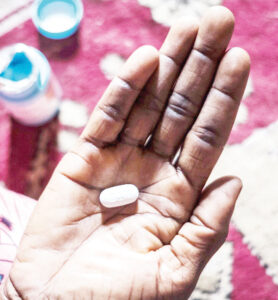
The Centres for Disease Control and Prevention (CDC) states that if taken as prescribed, HIV medicine reduces the amount of the virus in the body to a very low level, keeping the immune system working and preventing illness.
This is called viral suppression—defined as having less than 200 copies of HIV per millilitre of blood.
“HIV medicine can even make the viral load so low that a test can’t detect it. This is called an undetectable viral load,” CDC says.
It adds that another benefit of reducing the amount of virus in the body is that it prevents transmission to others through sex or syringe sharing and from mother to child during pregnancy, birth or breastfeeding.
During his visits to the hospital to have his viral load tested, Fred learnt that it was possible to not pass the virus to his wife if he religiously took his medication.
Joyce also had such information and it helped her even in ensuring her child did not contract the virus.
Now, the couple sometimes attend together sessions where those on treatment share ideas on how to stay healthy.
“We offered counselling to them, especially on how they could happily live together after initially hiding their serostatus from each other,” Makiyi says.
Now, the couple are among those who are actively taking part in Malawi’s push to reach the United Nations target to end Aids as a public health threat by 2023.
They often conduct door-to-door campaigns during which they urge people in their community to go for HIV tests and be in charge of their health.
“Even during our support group meetings, we encourage each other to continue taking our medication without defaulting to keep our viral loads low,” a member of a support group in Joyce’s area says.
The latest Joint United Nations Programme on HIV and Aids (UNAids) Global Aids Update released earlier this month “makes it clear” that there is a path to end the epidemic.
In the report’s foreword, UNAids Executive Director Winnie Byanyima cites Botswana, Eswatini, Rwanda and Tanzania as having already achieved the 95-95-95 targets.
The targets state that by 2025, 95 percent of people with HIV will know their status; 95 percent of people with HIV who know their status will be on treatment; and 90 percent of those on treatment should be virally supressed.
Byanyima is confident that at least 16 other countries, including eight in sub-Saharan Africa, are close to meeting the targets.
“Among [them] are low-income countries such as Malawi, which has targeted improvements and introduced tailored interventions in districts where testing and treatment coverage were lagging,” the UNAids report says.
According to the report, in 2022, an estimated 95 percent of people living with HIV in the country knew their HIV status, 98 percent of those who knew their HIV-positive status were receiving antiretroviral therapy (ART) and 94 percent of those on treatment were virally suppressed.
Malawi’s march towards the aims is being buoyed up by a campaign dubbed ‘Tingathe’, loosely translated as ‘We can do it’.
“Tingathe strongly believes that the global community is at a turning point in the fight against HIV and Aids, and that the resources, tools and knowledge are available to truly realise ‘control of the epidemic’,” a note on the programme says.
It adds that through a skilled, coordinated approach, it is possible to achieve an ‘Aids-free generation’ in Malawi.
But Makiyi insists that there still are pockets of incidences that are throwing spanners in the trudge towards a time when the epidemic should no longer be a public health threat.
“For instance, in some health facilities, someone has to walk some distance to another room to access ARVs if they test positive.
“Not everyone has the courage to do that. It would be better if all the services were available under one roof,” he says.
Makiyi also doubts Malawi’s ability to achieve the target of ensuring that 95 percent of people most at risk of HIV will have access to a combination of prevention services.
He notes that already some prevention products such as Pre-Exposure Prophylaxis (PrEP) are not available to all those who need them.
The health rights advocate further indicates that the “numerous questions and tests” that someone is subjected to when they seek PrEP deflates many from even attempting to ask for it.
“Still, we must pay tribute to everyone who is contributing to a reduction in new HIV cases. Scientists are doing a tremendous job to slow down the virus.
“Then there are also men, women, boys and girls who have the virus and faithfully take their medication and therefore reduce chances of infecting others,” Makiyi says.