By Kingsley Jassi:
Malawian businesses are starving, as domestic creditors seem elusive, with up to 90 percent of registered enterprises unable to access credit.
The World Bank’s Private Sector Diagnostic Survey finds that this is slowly weakening the industrial base and limiting productivity, as export volumes have been declining over the years.
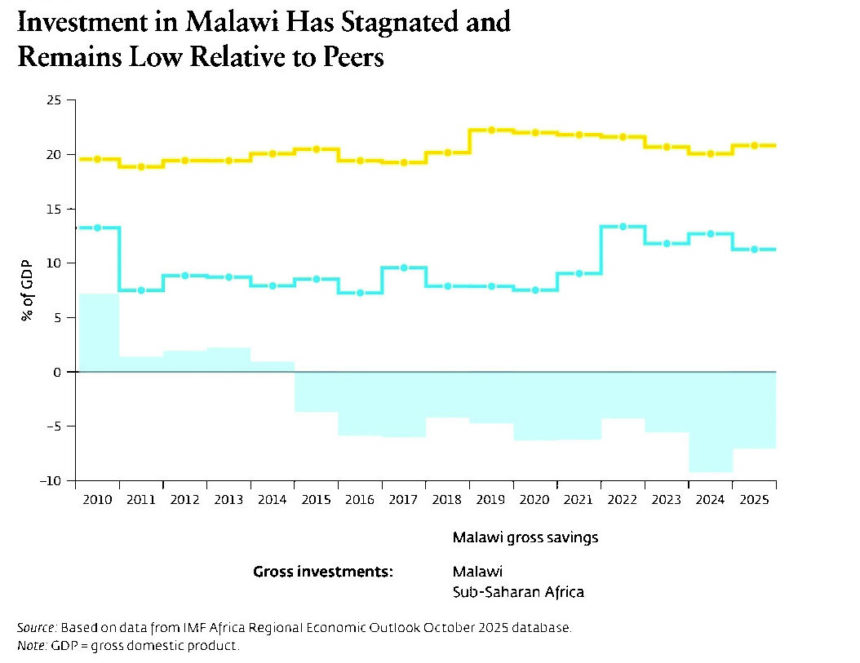
Gross investment rose above 20 percent of gross domestic product (GDP) in 2017 and 2019 but has been declining, reaching 11.1 percent by 2024, with the five-year average of 15 percent way below the regional peers’ average of 23 percent.
The bank sees foreign direct investment (FDI) averaging just 1.5 percent of the GDP, which fails to rejuvenate the weakening industrial base as businesses suffer high cost and limited access to finance and high transportation costs.
- Advertisement -
This continues to weaken the position of the country on international trade as it sits helplessly as a net importer, creating limited jobs, 40 000 annually, against the demand of 270,000.
This situation has, of late, pushed the country deeper into the poverty dugout.
GDP per Capita, which had peaked and closed the lower middle-income mark, has since dropped to $520, with 76 percent of Malawians living below $3 per day.
“This represents a substantially deeper level of poverty than nearly a quarter century earlier, in 1998,’ the World Bank says.
- Advertisement -
- Advertisement -
The bank reports that structural and macroeconomic imbalances have been exacerbated by policy choices that have contributed to Malawi having one of the lowest savings rates and growth rates in the world.
“Over the past five years, demand-side drivers of growth have been heavily constrained by fiscal and balance of payment pressures, persistently high inflation, exchange rate misalignment and rising public debt,” it reads.
Finance Minister Joseph Mwanamvekha cited, a fortnight ago, wrong policies that created what he termed “the economic mess”.
He was quick to say they would reverse the situation when he unveiled the National Economic Recovery Plan (NERP).
Relative to GDP, the five-year NERP will aim to reduce public debt from 90 percent to 60 percent, reduce inflation to 8.5 percent, raise revenue to 25 percent, ensure that exports are reaching above 20 percent while reaching the growth rate at 6.5 percent.
With a K3 trillion budget, the plan will heavily hinge on catalytic infrastructure development at a cost of K1.5 trillion, agriculture transformation valued at K1 trillion and K200 billion investment in mining and tourism, respectively.
The World Bank report sees these sectors generating up to $2 billion annually with the right policies and interventions.
In an interview, Malawi Confederation of Chambers of Commerce and Industry Chief Executive Officer Daisy Kambalame cited Public-Private Sector Dialogue as key to unlocking private sector potential in line with the NERP, a point Bankers Association of Malawi President Phillip Madinga echoed.