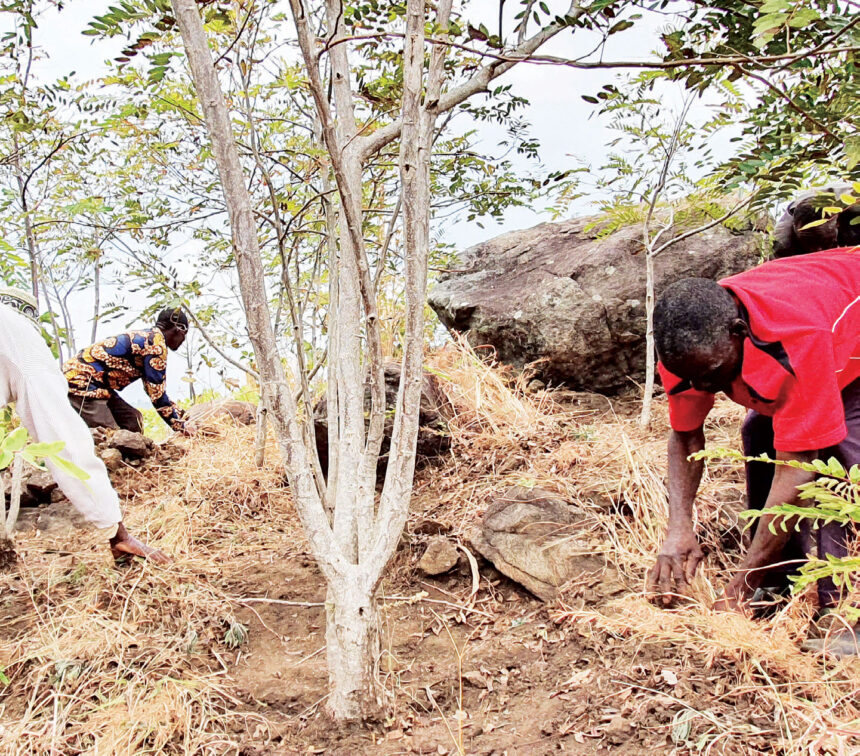
Tired of being pushed left, right and centre by environmental degradation-induced catastrophe, community members in Chadzunda, in the outskirts of Blantyre, are holding the bull by the horn by planting trees, creating a green forest of hope where once deserts were forming. THOMAS KACHERE writes.
As late as 2017, Nankumba Hill— once a habitat of rabbits, mice, Kalulu the Hare, among others, that thrived under the green canopy of hard and softwood trees— was a pale shadow of its former self.
This is because charcoal producers had cut hordes of trees to the ground, leaving only stumps as evidence of a hill that was once forested.
At first, John Machika and other community members just looked aside while trees were falling down, victims of the relentless axe.
No more.
“There came a point when we decided that enough was enough. What prompted us, community members, to act were problems such as the scarcity of firewood, mudslides and increased cases of floods.
- Advertisement -
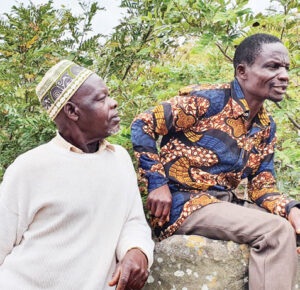
“Of course, we realised that, working as individuals, it would be difficult to arrest the problem. As such, we, community members, came together to tackle the problem as a united front. That is how we formed the 42-member Nankumba Community Based Organisation. One of the tasks we embarked on was a tree-planting one. Needless to say we are happy that, once again, trees are flourishing at Nankumba Hill,” Machika, who is the chairperson for the grouping, explains.
Not only has he become a conservationist; he has become an advocate of reforestation, too.
“Time has come for all Malawians and residents of Malawi to take control of their destiny, more so because the negative effects of climate change have spared no one. Today, the task at hand does not end when one plants trees; in fact, tree planting is the first of the processes because, after that, one has to take care of the trees. That way, we will play a role in restoring the rainfall pattern, which has lost track of itself because rains are no longer predictable.
“When people cut down trees wantonly, either for firewood or charcoal production, no place in the country is spared when it comes to effects of climate change. That is why we decided to come together and start planting trees and protecting them. We want to go back to a situation where we had thick bush with natural trees here,” he emphasised.
- Advertisement -
- Advertisement -
However, bringing people together to advance a common cause was no easy task.
Machika reminiscences that, initially, some community members were reluctant to join the cause.
However, after Machika and a few other individuals got in touch with the traditional authority, he did not only help them sensitise other community members to the importance of joining the cause; he left a hectare in the hands of the conservationists, who now take care of the hill.
“We were fortunate that our village head allocated a part of the hill to us. We now protect the trees, thanks to bylaws which we have formulated.
“The Ministry of Agriculture has been helpful, too; providing us with forestry experts who advise us on how best to take care of the trees,” a smiling Machika indicates.
Who can fault him?
Now the man-made forest has one million trees which, the conservationists hope, will serve community needs— such as when women prune dry branches for use as firewood.
“Learners from surrounding primary schools also stand to benefit as they will be using dry branches as firewood for cooking porridge for children,” the chairperson posits.
Local schools have been cooking porridge as part of the School Feeding Programme, which the government, through the Ministry of Education, has touted for improving school retention and enrollment rates.
According to Director of Technical Services in the Ministry of Education Godfrey Kachere, the ministry, in collaboration with the Ministry of Health, finds school feeding programming as both a necessary part of supporting teaching and learning and also assisting in improving the nutrition and health status of learners.
Lucy Guluka, another member of the group, concurs.
She adds that, apart from helping learners remain in school, trees that have been planted at the hill are addressing the problem of soil erosion, as water runoff cases have declined.
“Of course, some people were mocking us when we were planting these trees, telling us that we were embarking on something that attracted no wages.
“However, we stood our ground and, today, the fruits of our work are there for all to see,” Guluka reminiscences.
She is quick to say community members are already benefitting from forest resources, citing bee keeping as one of the flourishing activities there.
Events unfolding in Chadzunda have not escaped the attention of the government.
For instance, spokesperson for the Ministry of Natural Resources and Climate Change Frank Nkondetseni has hailed Nankumba CBO for the initiative.
“What the community in Chadzunda has done— that is, planting and protecting trees— is quite commendable. As you are aware, the Ministry of Natural Resources and Climate Change encourages community members, private sector players and non-governmental organisations, development partners and others, to collaborate with the Department of Forestry and participate in tree planting and management activities,” Nkondetseni points out.
The Malawi Government set a target to restore 4.5 million hectares of degraded forest landscapes by 2030.
However, the challenge has been acceptance of energy transition from charcoal to other alternatives, notably gas.

But Energy Minister Ibrahim Matola maintains that his ministry is making sure that more people are migrating from charcoal use to other alternatives like gas.
He explains that, at the moment, they are promoting the use of gas which, he says, is reliable and cheap.
“After holding conferences and exhibitions, there are now many centres where gas can be obtained, unlike in the past when it was very difficult to get gas because there was a sole dealer that was supplying gas. We also agreed with the Malawi Energy Regulatory Authority that we should go flat out with the campaign of educating the masses about gas usage,” Matola says.
United Nations Sustainable Development Goal 13 calls for urgent action to combat climate change and its impacts.
To address the problem of negative effects of climate change, countries also adopted the Paris Agreement to limit global temperature rise to well below 2 degrees Celsius.
On the same, goal number 15 requires countries to protect, restore and promote sustainable use of terrestrial ecosystems, sustainably manage forests, combat desertification, halt and reverse land degradation and halt biodiversity loss.
And, taking one step at a time, Chadzunda community members are contributing to these efforts.