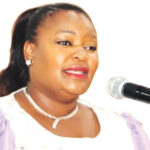

In May 2009, as Malawi prepared for the inauguration of President Bingu wa Mutharika to a second term, another event, quieter, more intimate, and infinitely more tragic, unfolded along the M5 Road in Mua near Mtakataka in Dedza District.
Susan Namangale’s Mercedes Benz, registration number KK 3809, collided with a truck belonging to Likanga Transport.
The collision was not merely violent; it was apocalyptic. Metal tore into metal. Her sister and her driver were fatally injured.
Flames swallowed the vehicle. Villagers gathered, some in shock, some in curiosity, and some, heartbreakingly, to loot from the wreckage while the wounded were still trapped inside.
Only one young boy stepped forward to help her pull unconscious bodies from the inferno.
- Advertisement -
Her sister died in her arms.
Sixteen years have passed. The flames died out long ago. The judgment has not come.
In the same year, the High Court heard Civil Accident Case No. 176. The presiding judge, Healy Potani, listened to testimony. He visited the scene of the accident. The hearing was concluded in 2010. Judgment was reserved.
And then, silence.
- Advertisement -
- Advertisement -
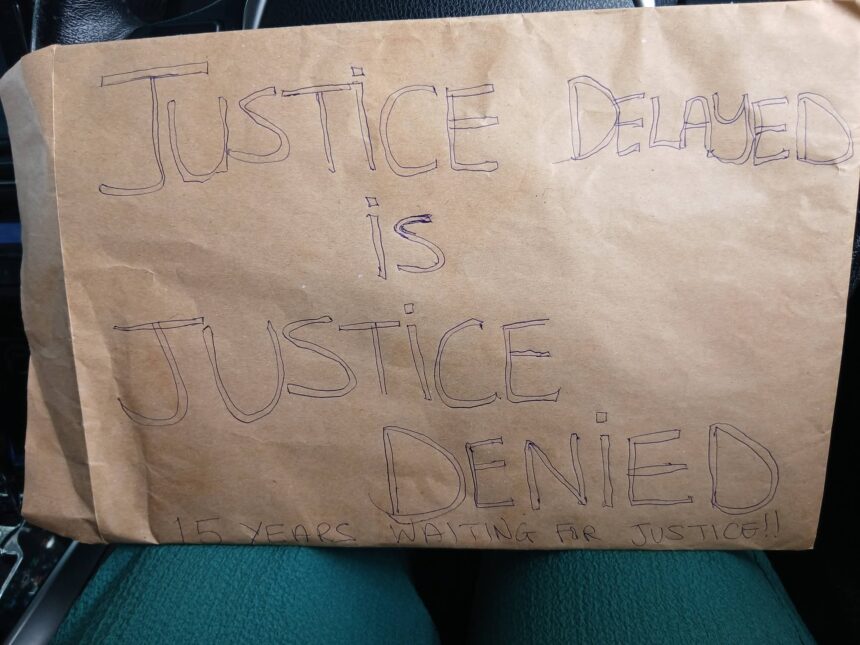
Sixteen reminders have been filed. Letters were written by her lawyer. Fifteen years have slipped by since the matter was concluded. The verdict remains undelivered.
Justice, in this case, has become an abstraction.
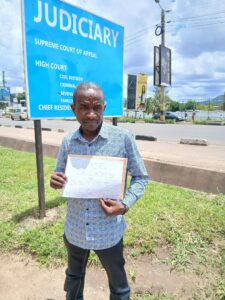
On Thursday, February 19, 2026, Namangale and fellow victim Gordon Maunde returned to the Supreme Court offices to file yet another reminder, a ritual that has now spanned a decade and a half.
“This case was being handled by Hon. Justice Potani and hearing was concluded in 2010 and despite numerous reminders both in writing and in person and aborted dates for delivery of Judgment, we are yet to be given any judgment for reasons that are yet to be communicated to us and the claimants keeps coming to our offices every month and we are unable to offer them any solace on the delay.
“This matter has been referred to Justice Madise as then Head of Judicial Complaints Committee in 2024 as well as last year, but we have had no response to date,” reads the reminder from her lawyer Senior Counsel Ralph Mhone of Racane Associates.
Overcome by emotion, Namangale raised her voice at a security guard over a parking infraction.
It was not in her nature, she says. It was the exhaustion speaking, the cumulative weight of waiting.
As she recounted her story to court officials, 2009 returned with piercing clarity.
She remembers Madam Susan Liwimbi, who had been traveling to attend the presidential inauguration, abandoning her journey to help at the accident scene, removing her jacket to keep Namangale warm as the shock set in.
And she remembers holding her sister as life slipped away.
The Mercedes Benz was the first and last she would ever own.
The son of her deceased driver was two years old at the time of the accident. This year, he sits for his Junior Certificate examinations. An entire childhood has unfolded between the hearing of a case and the absence of a verdict.
Time has moved. The court has not.
The judiciary is often described as the guardian of the rule of law, the last refuge of the ordinary citizen against arbitrariness and power. It commands neither the purse nor the sword. It commands trust.
And trust, once eroded, is difficult to restore.
Courts were established not merely to hear cases, but to conclude them. A justice system that allows a litigant to wait fifteen years for a judgment risks transforming hope into quiet despair. Others, less resilient, may die waiting. Some abandon their claims. A few continue knocking on institutional doors that may or may not open.
Centre for Social Accountability and Transparency Executive Director Willy Kambwandira says the prolonged delay in delivering judgment in a matter reportedly concluded in 2010 is deeply troubling and strikes at the heart of constitutional justice.
According to Kambwandira, when a case is concluded and yet a litigant waits more than a decade, despite numerous reminders, for a ruling, it ceases to be a mere administrative backlog and becomes a denial of justice.
“Justice delayed at that scale undermines public confidence in the judiciary, erodes the rule of law, and imposes emotional and financial strain on citizens who turn to the courts as their last resor
“While courts face capacity constraints, such an extreme delay is indefensible and calls for urgent institutional accountability, transparency, and reform,” he said.
Kambwandira said that where delays are excessive and unexplained, there must be transparent review mechanisms and consequences; otherwise, citizens are left to suffer in silence.
Centre for Democracy and Economic Development Initiatives (CDEDI) Executive Director Sylvester Namiwa has no kind words for the justice delivery system.
“This validates our stance that the Chief Justice, Rizine Mzikamanda, and his circle of senior judges should step down,” he says.
According to Namiwa, the justice system has been hijacked by cartels.
“This has culminated in the loss of trust in the once highly respected and independent judiciary. Without beating about the bush, justice in Malawi is for sale to the rich.
“Something ought to be done as a matter of urgency in order to preserve the iota of trust before it vanishes into thin air, a development that will put the legitimacy of the judiciary into serious question!” Namiwa says.
 Commenting on the Malawi Supreme Court of Appeal judgment in MSCA Civil Appeal No. 21 of 2016 filed by Finance Bank of Malawi Limited against the Reserve Bank of Malawi and the Attorney General, the Malawi Law Society observed that while it acknowledges the ongoing efforts by the Judiciary to improve the pace of justice delivery in Malawi, a twelve-year period to conclude an appeal is a matter of serious concern.
“Relatedly, the MLS calls upon the State President to expedite the appointment of the Judicial Service Commission, and upon the Public Appointments Committee of Parliament to appoint the Independent Complaints Commissioner for the Independent Complaints Commission of the Judiciary (ICCJ). The MLS further urges the Government to support the operationalisation of the ICCJ.
“The MLS believes that the implementation of the Constitution (Amendment) Act, 2025 and the Judicial Service Administration Act, 2025 will significantly address systemic challenges, enhance accountability, provide avenues for public redress, and strengthen public confidence in the Judiciary,” MLS said in a February 2011 statement.
Judiciary Spokesperson Ruth Mputeni asked for more time before commenting on the matter.
In early 2022, the Parliamentary Public Accounts Committee queried the Judiciary over a backlog of unconcluded cases.
Chief Justice Rizine Mzikamanda subsequently gave judges 90 days to deliver judgments on all their outstanding cases. However, many cases still remained unresolved.
In March 2023, former MLS president Patrick Mpaka told members at the Society’s annual general meeting in Mangochi that when an MLS–Judiciary special task force began engaging judges at the High Court’s Commercial Division over delayed cases, the Judiciary objected and described the MLS initiative as interference with judicial independence.
But for Namangale, judgment is tangible. And it has not arrived.
Sixteen years ago, a car burned on a national road in Dedza.
Today, what burns more slowly is something less visible but more consequential: the confidence of citizens who once believed that even if justice was slow, it would eventually come.
For Susan Namangale, the wait continues.
And in that wait lies a question far larger than one case: when justice is endlessly deferred, what becomes of the promise of the law itself?