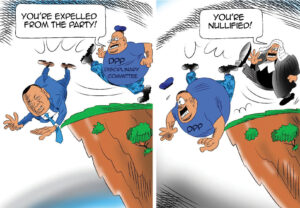
 The turmoil in erstwhile governing Democratic Progressive Party (DPP) is not ebbing away in the mists of time. It, in fact, appears to be intensifying, tactlessly so, just about two years before the next election.
It is all about who should become the party’s leader and, ultimately, its torchbearer at the 2025 presidential poll.
Having initially implied he would not contest for the topmost seat during the next election, DPP leader and former president, Peter Mutharika, has been endorsed by influential members of the party.
On July 3, DPP National Governing Council (NGC), which met in Mangochi, declared that the 83-year-old was the ideal candidate to lead the party at the election.
Undemocratic traits manifested in later declarations by some party senior members who argued the endorsement process itself was not as unanimous as DPP spokesperson Shadric Namalomba had claimed.
- Advertisement -
In his apparent acceptance of the endorsement, Mutharika said his party was democratic and that he was happy that all the differences that had inundated it had been buried.
It turned out they never were.
Pictures of DPP Southern Region vice president Kondwani Nankhumwa and Mutharika standing on one platform were mere decoys that attempted to hide the seething turmoil that had not been addressed.
It was just a few days later that a senior member of the party, Mark Botomani—believed to be siding with Nankhumwa— faulted his party for allegedly not giving a chance to some attendees of the meeting to ask questions.
- Advertisement -
- Advertisement -
Botomani, who also there at the Mangochi meeting, further claimed that delegates were not even accorded a chance to state if they had other candidates in mind that they thought would lead the party.
Apparently, DPP is doing everything possible to ostracise members who have ambitions to lead the party.
Chief among them is Nankhumwa, who has affirmed umpteen times that he is ready to face Mutharika at an elective convention.
Whatever the case, the bickering in the party is doing more detriment than good.
The numerous attempts that have been made by the Mutharika camp to get rid of Nankhumwa and company have clear tentacles of an establishment that is not willing to reform.
There are those who argue that some of Mutharika’s hangers-on are using the old man to advance their own agendas, and there seems to be some truth in such observations.
In any case, if those who are endorsing Mutharika really mean it and are doing everything in good faith, why not allow others who wish to challenge him to do so at the convention?
We all know that a party leader has more chances of being re-elected at a convention than anyone else.
Perhaps, it is true that the endorsement of Mutharika is a well-calculated move aimed at driving other aspirants further away from the throne while a preferred one is surreptitiously being groomed for the same seat.
The beauty—and sometimes spitefulness—of politics is that it often plays out in line within its name. The so-called Nankhumwa camp knows everything that the other side is doing, which may not really be what is being said out there.
So, the battle will not end with suspensions, expulsions or litigation.
Courts have offered their counsel in the past that political disagreements need to be addressed using political means.
They have detailed their reluctance to accept to be drawn into political battles, but have also avoided the temptation to renege on their duty of dispensing justice in all spheres of life.
Now, the disciplinary committee that was constituted by DPP, which summoned Nankhumwa over his holding of whistle-stop tours in the Southern Region, has been annulled by the courts.
The verdict, whether it will later be contested, in the meantime, is no success for anyone unless they do not wish the party well.
In fact, if truth be told, it is the governing Malawi Congress Party (MCP) that is glorying in the unending turmoil in DPP, and as far as politics is concerned, you cannot blame them.
They must be very happy seeing a main opposition political party being weakened through internal bickering and would even be interested in fanning the fire more and more.
Now, with the disciplinary committee that DPP constituted having been declared void by the courts, it remains to be seen how things will pan out in the case of Nicholas Dausi, who was expelled from the party as its publicity secretary and Member of Parliament.
In fact, Dausi claims to have never been charged— at least, as far as he knows— with any crime that resulted in the expulsion.
If his argument stands, it means whoever made the decision to fire him from DPP never gave him a chance to explain his side of the story.
Those are the undemocratic tendencies that are ruining the country’s main opposition political party.
In fact, it appears to be the obsession with Mutharika, which he obviously finds very gratifying, that is driving DPP down the chasm.