By Arnold Munthali, contributor
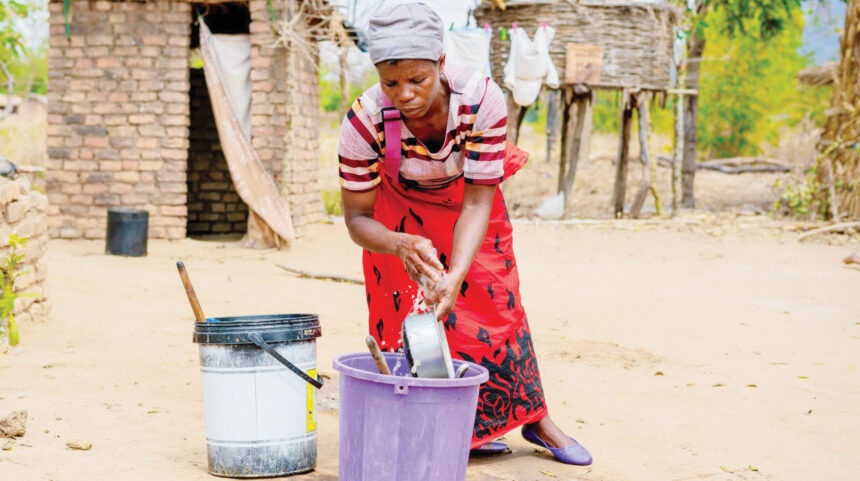
Magdalena Nyirenda recalls bitter memories of a period when people under Group Village Head (GVH) Galang’anda at Mwazisi Trading Centre in Rumphi relied on a winch-operated shallow well, constructed by benefactors in 1997, and a more recent hand-pump established within the past three years.
The shallow well, Nyirenda says, exposed the community to cholera, other waterborne diseases, and malaria, as it served as a breeding ground for mosquitoes.
Besides, the 42-year-old mother of five explains that the poorly covered well also posed a risk of drowning children.
As Vincent Horowanya, the District Water Officer for Rumphi Council, explains, these challenges emanate from its hilly topography and a lack of sustainable technologies capable of supplying water throughout the year.
- Advertisement -
But, with installing a solar-powered water distribution system at Mwazisi Health Centre, the wells at Mwazisi now appear as monuments to a bygone era.
The health centre and its surrounding communities benefit from a water, sanitation and hygiene (Wash) project implemented by Unicef, with financial backing from the Bureau of Humanitarian Assistance through the United States Agency for International Development.
Similar initiatives are also taking place in Blantyre, Chikwawa, Machinga, Mangochi, Nkhata Bay, Nkhotakota, Rumphi, Salima and Zomba.
The project aims to construct Wash facilities at selected health centres in the named districts to enhance access to improved climate-resilient water supply services in communities and healthcare facilities.
- Advertisement -
- Advertisement -
At Mwazisi Heath Centre, Unicef has installed a solar-powered deep well and two 20,000-litre water tanks.
In addition, the project has constructed handwashing facilities at the health centre and provided six communal water points.
These water points consist of two at the health centre, one each at Mwazisi Primary School, the market, the church and the community.
The implementation of the water system has greatly facilitated the work of the health centre staff and has significantly eliminated conflicts with the surrounding communities, explains Verson Chenje, a Senior Health Surveillance Assistant at the health centre, who has witnessed first-hand the transformation of the area during his 16 years of service at the facility.
When he first joined it, Chenje recalls, the health centre did not have reliable water supply. This forced patients, their guardians and pregnant women to fetch water from boreholes located at a considerable distance from the facility.
“We were later connected to the national electricity grid. A water tank was installed, which utilised electric power to pump water from a borehole for use at the health centre. However, this development brought its own set of problems.
“During blackouts, people had to fetch water from unprotected wells far away from here. Additionally, community members were also using the same water tap as the health centre, leading to congestion and frequent damages to the tap,” Chenje explains.
The installation of the solar-powered water system was intended to address the issue of blackouts, electricity bills, communal conflicts and quality of care at the health centres.
As Chenje affirms, those problems are now a thing of the past. The tap at the health centre no longer gets damaged frequently. Guardians, patients and pregnant women can easily access water within the facility.
Furthermore, the community is no longer a source of inconvenience, as there are now four water points scattered throughout the area.
According to Chenje, the health centre now receives fewer cases of scabies and diarrhoeal diseases.
The water points serve approximately 3,000 people in GVH Galang’anda area, and no one is prouder of this development than the chief himself.
“This project has brought about remarkable transformation in my village. Previously, my people had to travel long distances to fetch water for domestic use.
“However, now we have water readily available. This is especially beneficial for us, considering the recent cholera pandemic,” the chief, whose real name is Vincent Nyasulu, says.
Nyasulu is also the head teacher of Mwazisi Primary School, which also benefited from the installation of a water point.
The water point at the school was established towards the end of the last academic year, in June, and Nyasulu is optimistic it will have a positive impact on the performance of learners, particularly girls.
“It has provided a significant amount of water as girls require a substantial amount of water for their use, and the school feeding programme necessitates readily available water,” he states.
Maureen Nyasulu, a standard eight learner at the school, explains that they faced challenges as girls, often having to rush home to wash themselves.